SEOULIAN INTERPRETATION · Give the empty space a second look
A palace asks you to notice a gate or a roof. A house foundation asks something quieter: where would someone have stood, and how would they have reached the next house? At Gongpyeong Historic Sites Museum in central Seoul, that is a useful way to begin. Look at the spaces between structures before treating each structure as a separate exhibit.
The museum sits on the first basement level of Centropolis, at 26 Ujeongguk-ro in Jongno-gu. Its subject is the older city uncovered during redevelopment of the site. For an English-speaking visitor, the attraction need not be a long list of historical names. A route, a boundary and the outline of a room offer a visual starting point.
VERIFIED CONTEXT · A neighborhood, presented below ground
Seoul's opening account dates the museum to September 12, 2018. Excavation in 2014–2015 identified building sites and passages, together with everyday objects. The displays concentrate on the appearance of Hanyang, the city's earlier name, in the sixteenth and seventeenth centuries. This is an established museum, not a newly announced opening.
The Seoul Museum of History describes three house sites as central exhibits, interpreted through different formats: small-scale models, a full-size reconstruction and virtual-reality presentation. Its gallery descriptions also identify a glass-floor deck and the Imunan-gil and Jeon-dong alley routes. These are different ways of explaining a place, not interchangeable proof of what survives unchanged.
Independent reporting by Jon Dunbar in The Korea Times in March 2019 likewise records stone foundations and reconstructed hanok at the site. That dated account corroborates the mixture of remains and interpretation. It is not evidence that a particular headset or interactive feature is available today.
TRY IT · Read one house in three passes
First, choose one house site and follow the boundary you can actually see. Where does it turn? Which parts are continuous, and which need a label or plan to explain them? Resist completing the entire building in your imagination immediately. Noticing what is missing is part of looking carefully.
Next, compare that footprint with its interpretation. A miniature makes the overall shape easier to grasp; a full-size reconstruction can help suggest bodily scale. Ask which details come from excavated evidence and which are explained through reconstruction. The display label matters more than how convincing the finished scene looks.
Finally, turn toward the alley. Think about the distance from an entrance to a shared route and about how neighboring buildings meet. This is a suggested observation exercise, not an archaeological conclusion about a particular family's daily routine. You do not need to invent a resident's story to find the arrangement absorbing.
PLAN THE VISIT · Find the basement, then take your time
The museum's official English page lists free admission and hours of 9 a.m. to 6 p.m., Tuesday through Sunday, with closures on Mondays and January 1. Its subway direction is Jonggak Station, Line 1, Exit 3-1. Save both the museum name and the Centropolis basement address so a map search takes you to the intended site.
For a simple visit, choose one house and one alley instead of trying to decode every display. Read from the designated visitor route and follow the on-site guidance around remains and reconstructions. If an English-language explanation or a specific access arrangement is important to your visit, ask the museum in advance rather than assuming it is available on arrival.
Hours and access information were checked on September 18, 2026 (UTC). Consult the linked museum page and notices again before traveling, especially around holidays. The reward here is a different scale of attention: a modern city becomes easier to read when its older rooms and passages are allowed to remain questions, not just a backdrop for a photograph.
THE SEOULIAN SIGNAL · EDITORIAL INTERPRETATION
Why this matters
Read a foundation and its reconstruction as two different kinds of information. Then follow the space between houses: the alley can make a neighborhood easier to imagine than an isolated object.
SOURCE DESK · RESEARCH RECORDS
Research used for this analysis
- Gongpyeong Historical Sites Museum — November 16, 2018 Seoul Metropolitan Government · Official dated opening account: September 12, 2018 opening, excavation period, neighborhood remains and sixteenth–seventeenth-century display focus. Rechecked September 18, 2026 UTC; not presented as new opening news. No photographs or text reused.
- Gongpyeong Historic Site Museum — official branch and visitor information Seoul Museum of History · Operator's account of house sites, model scales, reconstruction and glass deck; current listed address, free admission, 09:00–18:00 Tuesday–Sunday, Monday/January 1 closures and Jonggak Exit 3-1. Checked September 18, 2026 UTC. Same institutional source family as Seoul city, not counted as an independent publisher. No guarantee of daily interactive availability.
- Gongpyeong museum reveals struggle with preservation — March 5, 2019 The Korea Times · Jon Dunbar · Independent, dated site reporting corroborating the basement setting, stone foundations and hanok reconstructions. Checked September 18, 2026 UTC. Used only for those physical observations, not as a current-service check, endorsement of every historical statement or adoption of the author's wider redevelopment argument. No quotations or photographs reproduced.
Original synthesis & image rights
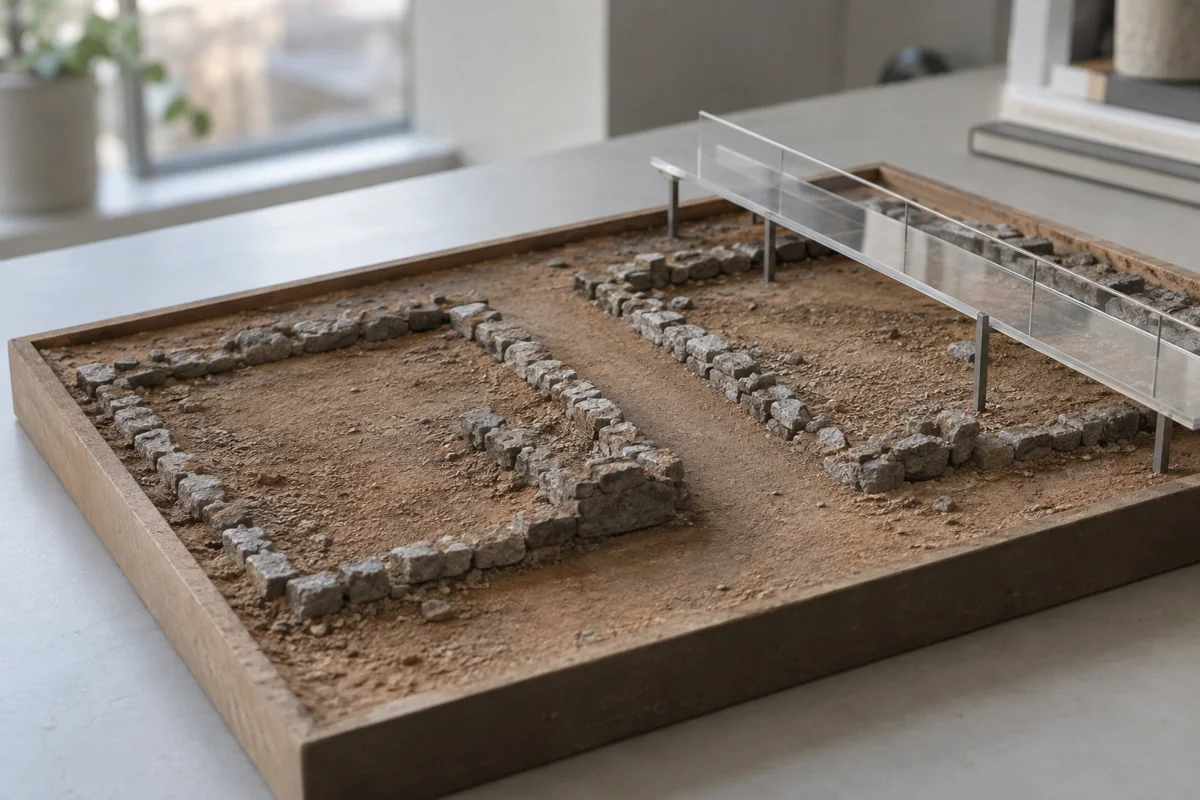
Original SEOULIAN English synthesis, not a translation, copied itinerary or eyewitness review. Official sources and independent reporting support the stated facts; their wording and photographs are not reproduced. The built-in ChatGPT Image Generation cover shows an invented contemporary tabletop model, not Gongpyeong Historic Sites Museum, a real excavation or a museum-owned model. AI-generated editorial illustration; not documentary evidence. Targets and reported usage remain attributed to the city and are not presented as independently verified outcomes.
Image disclosure
Credit: SEOULIAN · Created with ChatGPT Image Generation.
Creator: SEOULIAN with ChatGPT Image Generation
Source type: SEOULIAN imagegen editorial photo
Disclosure: AI-generated editorial illustration; not documentary evidence. A fictional contemporary tabletop model, not Gongpyeong Historic Sites Museum, an actual excavation or a museum-owned model.
License: Original SEOULIAN AI-generated editorial image