Paste and finished dish are different things
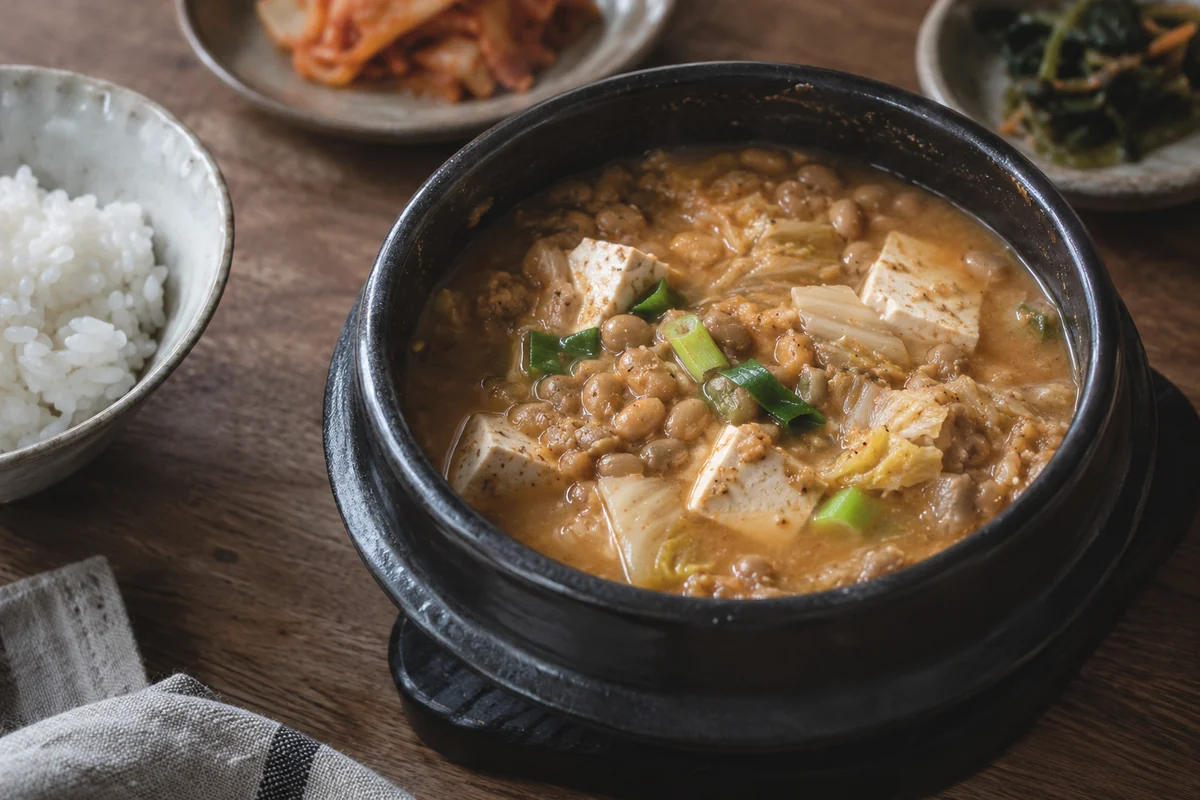
Cheonggukjang refers to a fermented soybean preparation that also gives its name to a familiar stew. The Academy of Korean Studies describes a short-matured bean preparation and its use in jjigae, while the national tourism organization introduces the finished stew with ingredients such as tofu and kimchi.
That distinction matters when reading a menu. Information about the paste does not establish every ingredient in the bowl. Stock, additional seasoning and other components belong to the kitchen’s preparation, even when the fermented beans give the stew its most recognizable aroma.
Ask beyond the smell
SEOULIAN’s practical suggestion is to ask what accompanies the beans: tofu, vegetables, meat, seafood-based stock or other additions. A vegetarian-looking surface is not enough to identify the stock. Likewise, a description of how a paste is fermented is not a statement about the sodium or other properties of the finished meal.
The first taste can also separate smell from texture. Notice whether the beans remain perceptible, how the liquid coats the spoon and what the tofu or vegetables contribute. Those observations are more useful than assuming that a stronger aroma automatically means a hotter or heavier dish.
An introduction, not a fermentation tutorial
This article does not reproduce a home-fermentation procedure or make health claims. Fermented-food discussions can easily move from culinary description to promises the sources do not establish. Here, the purpose is to make an order more understandable and to distinguish an ingredient from the complete dish.
For a packaged paste, read the actual ingredient and storage instructions. At a restaurant, let the kitchen answer preparation questions. Cheonggukjang need not be approached as a challenge to endure; it can be understood as a bean-centered stew whose aroma is only one part of how it tastes and eats.
THE SEOULIAN SIGNAL · EDITORIAL INTERPRETATION
Why this matters
SEOULIAN editorial reading: Distinguishing fermented soybean paste from finished jjigae. This is a practical interpretive angle, not a popularity claim.
SOURCE DESK · RESEARCH RECORDS
Research used for this analysis
- Cheonggukjang jjigae food guide Korea Tourism Organization · Fermented soybean stew with varying additions
- Cheonggukjang — Encyclopedia of Korean Culture Academy of Korean Studies · Specialist account of short-fermented soybean preparation and use in stew
Original synthesis & image rights
Original English synthesis by SEOULIAN from independently checked factual sources. No source prose, third-party photographs, artwork or recordings reproduced. Targets and reported usage remain attributed to the city and are not presented as independently verified outcomes.
Image disclosure
Credit: SEOULIAN · Created with ChatGPT Image Generation.
Creator: SEOULIAN with ChatGPT Image Generation
Source type: SEOULIAN imagegen editorial photo
Disclosure: AI-generated editorial illustration; not documentary evidence. A conceptual cheonggukjang stew, not a copy of a published recipe photograph. SEOULIAN · Created with ChatGPT Image Generation.
License: Original SEOULIAN AI-generated editorial image