START WITH THE WORD · A textile hair ornament
A ribbon can change a hairstyle without changing its cut. Length, fold and placement make a small piece of fabric part of the whole silhouette. In Korea, daenggi names a family of textile hair ornaments whose uses are more varied than one familiar image of a ribbon at the end of a braid.
The National Folk Museum of Korea's Clothing of Korea defines daenggi as cloth ribbons used to tidy or decorate hair. Its entry notes different lengths, widths and forms for different functions. That is a useful beginning: the term identifies a category, not a single standardized bow.
For readers exploring Korean beauty, the interest here is hair styling as material design. This is a museum-based introduction, not a claim that a particular accessory is currently viral, universally worn or a requirement for dressing correctly.
ONE OBJECT · Look at how it is built
The Seok Juseon Memorial Museum at Dankook University documents a nineteenth-century goi-daenggi associated with special occasions in northwestern Korea. Its description identifies black satin, cotton padding, embroidery and coral and pearl beads. The fabric is shaped into a padded form rather than left as an ordinary flat strip.
That example matters because the category's fabric foundation does not mean every surviving object is undecorated or made of cloth alone. A definition and a particular collection object answer different questions. Read the object's own record before transferring one general description to every version.
A separate National Folk Museum collection record identifies a large daenggi made with silk in a leno weave. The two institutions' records offer contrasting points of entry: construction and ornament in one, textile material in another. They are examples, not a complete history of every region or wearer.
THREE THINGS TO NOTICE · Length, surface, placement
First, look at the outline. Does the accessory make a long line, a compact folded shape or a fuller volume? Next, look at the surface: does interest come from the fabric, an embroidered detail or an added ornament? Finally, ask how the piece relates to the hairstyle rather than studying it as an isolated decoration.
These are our suggested observation questions, not instructions for reconstructing a historical hairstyle. A catalog image may not show the back, fastening or full wearing arrangement. If those details matter for a performance or an accurate costume, seek documentation instead of inventing the missing parts.
The same questions can make a modern accessory easier to describe. Saying that you like a long fabric line or a softly folded shape is more precise than asking for something that simply looks Korean.
TODAY'S CHOICE · Inspiration is not a museum label
If a contemporary maker calls an item daenggi-inspired, ask what the phrase refers to: the material, the way it ties, a documented form or a loose visual reference. A modern interpretation can be enjoyable without being sold as an exact reproduction.
There is no need to copy a ceremonial object to appreciate the design. Start by noticing how fabric behaves beside hair, and choose an accessory that suits your own preferences and occasion. The historical records make that choice richer by giving names and context to details that might otherwise pass unnoticed.
THE SEOULIAN SIGNAL · EDITORIAL INTERPRETATION
Why this matters
Daenggi is a family of textile hair ornaments. A particular museum example can have added decoration that a short generic definition does not capture.
SOURCE DESK · RESEARCH RECORDS
Research used for this analysis
- Clothing of Korea · Daenggi, printed page 253 National Folk Museum of Korea · Primary reference definition and varied functions; relevant PDF page read. Under 100 derived words; broad fabric-only wording qualified by specific museum object.
- Goi-daenggii, Hair Ribbon · nineteenth-century collection record Seok Juseon Memorial Museum, Dankook University · Independent museum's primary object record: regional occasion, construction and materials. Under 100 derived words; no photograph copied.
- Big Daenggi (Hair Ribbon) · collection record National Folk Museum of Korea · Primary separate artifact identifies silk leno weave. Missing dimension units not inferred; no image reproduced.
Original synthesis & image rights
Original SEOULIAN museum-based synthesis. Historical examples kept specific to their collection records; generic definition not used to erase decorated variants. No museum photographs, patterns, artifact replicas, current-trend claims or costume-authenticity guarantees. Unique Imagegen illustration. Targets and reported usage remain attributed to the city and are not presented as independently verified outcomes.
Image disclosure
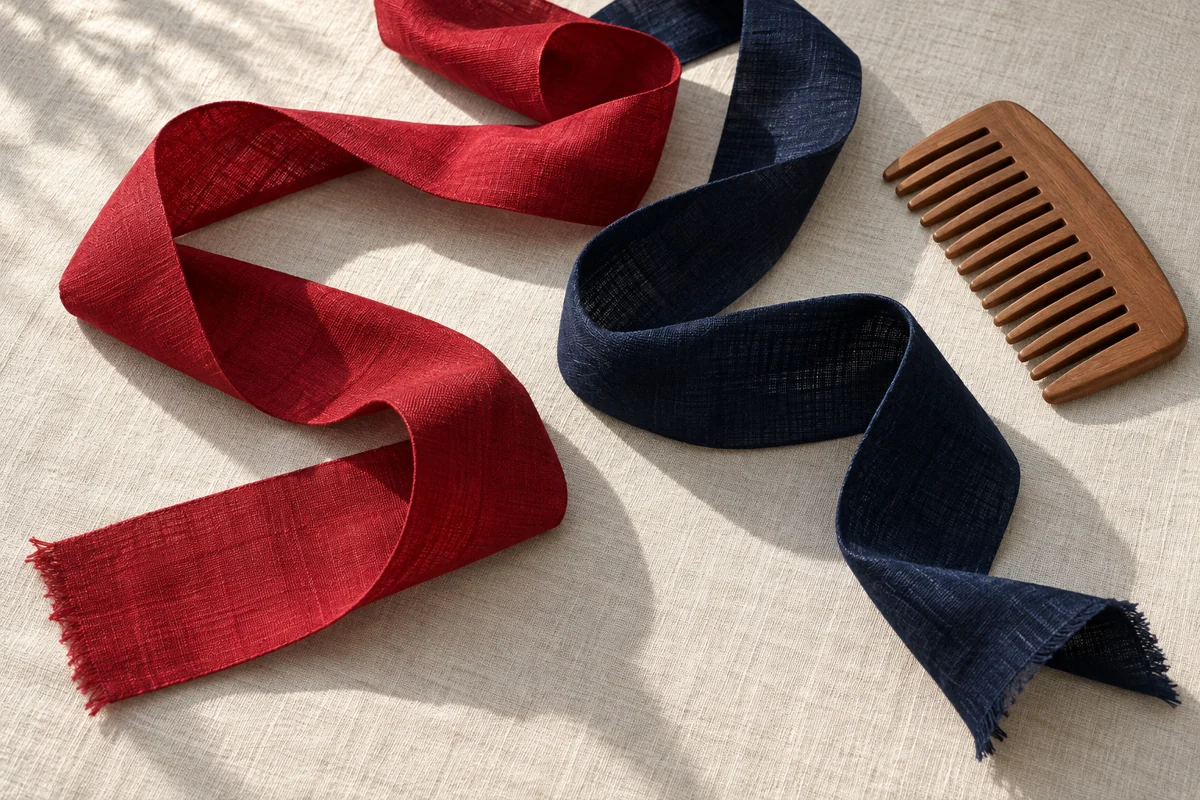
Credit: AI-generated editorial illustration; not documentary evidence. Invented textile still life, not an authenticated daenggi, historic wearing arrangement, museum artifact or exact reproduction.
Creator: SEOULIAN with ChatGPT Image Generation
Source type: SEOULIAN imagegen editorial photo
Disclosure: AI-generated editorial illustration; not documentary evidence. Invented textile still life, not an authenticated daenggi, historic wearing arrangement, museum artifact or exact reproduction.
License: Original SEOULIAN AI-generated editorial image