SEOULIAN INTERPRETATION · Change the question at the menu
If your mental picture of Korean cold noodles is a steel bowl filled with icy soup, leave room for another possibility. Look for deulgireum makguksu (들기름 막국수): buckwheat noodles dressed with perilla oil. Instead of asking only whether the noodles are hot or cold, ask what carries the flavour—broth, a sauce, or oil.
That small change makes a menu easier to read. It also offers a different entry into Korean food for someone whose reference points are a grill and a red chilli sauce. This is a guide to understanding a dish, not a restaurant review, a tasting we attended, or a claim that every kitchen makes it identically.
VERIFIED CONTEXT · The oil is the point
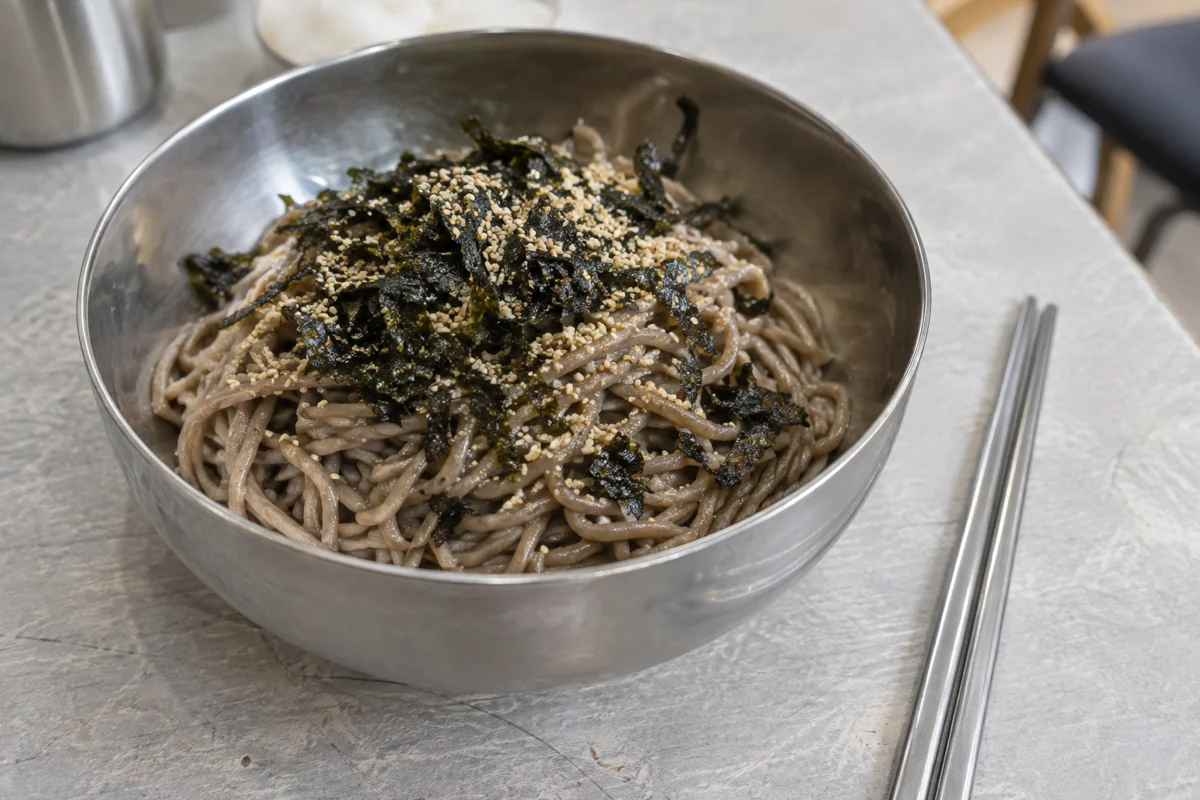
Korea Tourism Organization's food entry describes a perilla-oil version of makguksu with seaweed and ground sesame. In a separately reported cold-noodle guide, The Korea Times describes the noodles as drained and tossed with perilla oil. The common point is the dressing, not a large quantity of soup.
Makguksu itself has a broader range. Both institutions connect it with Gangwon, and describe versions involving kimchi or other broth. The longer name matters: an order for makguksu alone does not necessarily mean the oil-dressed bowl you had in mind. Keep the Korean spelling of the version you want, then confirm what that particular restaurant serves.
The tourism entry dates from October 2023 and the newspaper guide from June 2025. They establish the dish's description; they do not prove that it is newly trending this week. We are recommending a useful food discovery, not announcing a fresh sales record or a national favourite.
READ THE NOODLE · Colour is not an ingredient list
VISITKOREA's broader noodle guide explains that makguksu dough can combine buckwheat with wheat flour or starch. It also describes versions made entirely from buckwheat, whose strands hold together less readily. There is no single texture promised by the word on the menu.
Our practical suggestion is to separate two questions: what is in the noodle, and what is added to it? A photograph may help you recognise the presentation, but it cannot establish the flour blend or the full dressing. If ingredients matter to your diet, ask the kitchen or read the package rather than treating the dish name as a guarantee.
There is no need to turn this into a purity test. A more resilient strand and a more fragile one can offer different pleasures. Ask what the maker intended, and describe what you notice without ranking the entire cuisine from one bowl.
AT THE TABLE · Try a small comparison
Here is an optional tasting exercise, not a rule of Korean etiquette: take one small bite as the kitchen serves it before reaching for anything else on the table. Notice the noodle's texture, the aroma and the way the dressing coats it. Then decide whether you want an adjustment, asking staff first if the serving instructions are unclear.
If you are eating with someone who chooses a broth-based bowl, compare your impressions in words: does the flavour arrive through the liquid, through the coating, or through the garnish? You can learn something together without ordering extra dishes or assuming everyone wants to share food.
For planning, use three simple checks: is the perilla-oil version actually on today's menu; what are the noodle and dressing ingredients; and what is the current price? This article does not recommend a specific business or reproduce older restaurant prices as current offers.
TAKE IT WITH YOU · A more precise food memory
After the meal, save the full dish name and one observation rather than only a photograph. 'I liked the oil-dressed version' is a more useful starting point for your next order than 'I liked those cold noodles.' It leaves room for a second bowl to be different—and for you to discover why.
THE SEOULIAN SIGNAL · EDITORIAL INTERPRETATION
Why this matters
Save the full name 들기름 막국수, then confirm the dressing and flour blend. Makguksu is not a promise of one broth, recipe or texture.
SOURCE DESK · RESEARCH RECORDS
Research used for this analysis
- Buckwheat Noodles with Perilla Oil, October 19, 2023; accessed September 14, 2026 Korea Tourism Organization · VISITKOREA · Primary national tourism food reference: full dish name, perilla-oil preparation, seaweed and ground sesame. Nutrition and popularity claims are not adopted.
- Guide to naengmyeon, Korea's summer noodles, June 28, 2025; updated July 4, 2025 The Korea Times · Kim Se-jeong · Independent newsroom corroboration of Gangwon makguksu and the drained perilla-oil version. No wording, historical narrative or licensed images reproduced; read September 14, 2026.
- Korea's Favorite Noodles, February 2, 2024; accessed September 14, 2026 Korea Tourism Organization · VISITKOREA · Flour-blend and texture context, Gangwon association and broth variations. Same institution as the first source, not a third independent organisation; listed restaurant prices and hours are not reused.
Original synthesis & image rights
Original SEOULIAN synthesis of facts from Korea Tourism Organization and independently authored Korea Times reporting, with original menu-reading and tasting questions. No source prose, recipe, restaurant photograph or artwork reproduced. The two tourism pages are one institution. Built-in Imagegen created the fictional, disclosed cover; no firsthand meal, health benefit or current popularity claim is made. Targets and reported usage remain attributed to the city and are not presented as independently verified outcomes.
Image disclosure
Credit: AI-generated editorial illustration; not documentary evidence. A fictional serving of perilla-oil buckwheat noodles, not a photograph from a restaurant or firsthand tasting.
Creator: SEOULIAN with ChatGPT Image Generation
Source type: SEOULIAN imagegen editorial photo
Disclosure: AI-generated editorial illustration; not documentary evidence. A fictional serving of perilla-oil buckwheat noodles, not a photograph from a restaurant or firsthand tasting.
License: Original SEOULIAN AI-generated editorial image