VERIFIED FACT · Three days at COEX, with registration open
Smart Life Week 2026 is scheduled for Tuesday, October 6 through Thursday, October 8 at COEX in Gangnam. Seoul’s current municipal notice says pre-registration runs through October 5 and gives registered visitors free access to the exhibitions, with major forums and hands-on programs also available. Capacity, session times, or separate booking may still apply to individual programs, so registration is a starting point rather than a promise of entry to every room. Check the live organizer page again before traveling.
The announced public exhibition is split across two main spaces: a future-city showroom in Hall A and the Seoul AI Robot Show in Hall B. Seoul describes Hall A as eight Seoul-inspired settings—including places modeled on Gwanghwamun, the Hangang, Seoul Station, a library, Bukchon, and DDP—used to frame physical AI, public administration, safety and care, mobility, and education. These are demonstrations, not proof that every displayed service is already operating citywide.
ARRIVAL PLAN · Pick the subway entrance that matches your first hall
COEX’s current directions page lists two direct indoor approaches: Samseong Station on Line 2 via Exits 5 or 6 and Bongeunsa Station on Line 9 via Exit 7. The venue address is 513 Yeongdong-daero, Gangnam-gu. Because the complex is large, save the event’s live floor information before entering and navigate to Hall A or Hall B—not merely to ‘COEX.’ Indoor navigation and program assignments can change, so recheck the official event page on the morning of the visit.
A useful visit needs less time than a complete one. Allow about two to three hours for one hall, one forum or guided component, and a short written review; that duration is SEOULIAN advice, not an official estimate. If robots are the main interest, start in Hall B. If the question is how AI may change ordinary public services, begin in Hall A, then use the robot hall as a comparison rather than a finale of bigger machines.
THE HUMAN TEST · Name the task before judging the technology
At each demonstration, first name the ordinary task in one plain sentence: finding the right counter, crossing a street, receiving help, learning a route, understanding a form, or moving an object safely. Then ask four questions. Who benefits? What must the person provide? What happens when the system is wrong? Can someone decline it and still complete the task? A polished demo may be impressive while leaving those questions unanswered.
Next, look for recovery rather than perfection. Does the system explain an error, offer a human handoff, work for someone who cannot hear or read the default language, and show what information it keeps? Do not enter sensitive personal data into an unfamiliar demonstration. Ask staff before photographing people or screens, and avoid presenting a staged result as evidence that the same performance will hold in a crowded street, hospital, station, or home.
READ THE SCALE · Targets, attendance, and capability are different facts
The official 2026 overview announces a scale of more than 500 cities and companies and more than 70,000 participants. Those are event targets or planned scale, not a completed attendance count. For comparison, Seoul reports that the 2025 edition recorded 60,605 visitors, 130 cities, and 330 companies; Korea Times independently reported the same broad baseline when covering the 2026 registration launch. Neither figure tells a visitor whether a particular robot or city service works well.
The opening program is scheduled to begin at 11 AM on October 6, with robotics researcher and Boston Dynamics founder Marc Raibert announced as a keynote speaker. Treat speaker names and program times as changeable event information. The practical value of the show is wider than a stage: the official program also lists floor tours, audio guides, conferences, city awards, company presentations, and meetup spaces. Choose one format that lets you ask a question, not only watch.
MAKE A FIELD NOTE · One promise, one observation, one missing answer
For each exhibit worth remembering, write three lines. First, record the presenter’s promise in your own words and label it as a claim. Second, record only what you actually observed: the task, conditions, response, delay, and any staff assistance. Third, name the missing answer, such as cost, maintenance, accessibility, privacy, energy use, failure rate, or who is accountable after deployment. This small separation keeps curiosity from turning into free promotion.
Finish by comparing two exhibits that address the same human need in different ways. A robot may carry something; a redesigned counter or clearer sign may remove the need to carry it. An AI guide may translate; a multilingual form may solve the problem without automation. The strongest future-city idea is not necessarily the most theatrical one. It is the approach that reduces friction without creating a new burden for the person least able to absorb it.
SEOULIAN INTERPRETATION · The exhibition is most useful as a public rehearsal
A city-technology expo can easily become a corridor of confident futures. The more interesting reading is to treat it as a rehearsal where residents and visitors can test the script. Seoul’s decision to organize the main showroom around familiar urban settings gives the audience a practical advantage: each idea can be compared with a place they can actually walk through before or after the event.
Leave COEX with one question for the real city. Does the station route feel easier than the mobility demo? Is public information outside the hall as legible as the interface inside it? Could a person with limited time, language, money, mobility, or technical confidence use the service without special help? That walk from prototype to street turns an expo visit into something generous: attention paid to how other people may have to live with the future.
THE SEOULIAN SIGNAL · EDITORIAL INTERPRETATION
Why this matters
Pre-register through the official Smart Life Week site by October 5, confirm any program-specific booking, and navigate to a hall rather than only to COEX. Start in Hall A for city-service questions or Hall B for robots, then test each display against one ordinary human task.
SOURCE DESK · RESEARCH RECORDS
Research used for this analysis
- Experience AI-Powered Future Cities in Seoul at Smart Life Week (SLW) 2026—Pre-Registrations Now Open Seoul Metropolitan Government · Primary English municipal announcement used for the October 6–8 dates, COEX Halls A and B, August 10 registration opening, free exhibition access for pre-registered visitors, eight-setting showroom, robot show, program types, keynote announcement, and reported 2025 attendance baseline.
- Smart Life Week 2026 Event and Pre-Registration Notice Seoul Metropolitan Government · Current Korean municipal notice used to cross-check the October 6–8 dates, COEX hall locations, October 5 registration deadline, registered-visitor access terms, keynote timing, showroom themes, robot-hall plan, and additional program types.
- Seoul Smart City Prize Announces 46 Semi-Finalists for Its 2026 Edition World Smart Sustainable Cities Organization · Co-host record used to cross-check the COEX venue and October 6–8 event dates and to verify that the 2026 smart-city prize ceremony is scheduled during Smart Life Week.
- Directions COEX · Current venue page used for the 513 Yeongdong-daero address and the direct indoor approaches from Samseong Station Exits 5–6 and Bongeunsa Station Exit 7.
- Seoul to Hold Event Offering Glimpse into Fully Automated City The Korea Times · Independent English reporting used to cross-check the event dates, COEX venue, registration launch, physical-AI emphasis, co-hosting structure, and the prior edition’s scale.
- Smart Life Week 2026 — Domestic Exhibition Schedule Korea Exhibition Industry Association · Independent industry-association listing used to cross-check the October 6–8 dates, COEX venue, organizers, and exhibition category.
Original synthesis & image rights
SEOULIAN independently synthesized and checked the event dates, registration status, hall plan, announced scale, access, and prior-edition figures from current Seoul Metropolitan Government, COEX, Korea Exhibition Industry Association, WeGO, and Korea Times records. No source sentence, press photograph, poster, logo, robot design, booth design, venue map, interface, speaker likeness, or sponsor material is reproduced. The cover is an original AI-generated editorial illustration made with built-in ChatGPT Image Generation for this story and recorded with its prompt, source PNG, optimized WebP, hashes, and visible disclosure. Targets and reported usage remain attributed to the city and are not presented as independently verified outcomes.
Image disclosure
Credit: SEOULIAN · Created with ChatGPT Image Generation
Creator: SEOULIAN with ChatGPT Image Generation
Source type: SEOULIAN imagegen editorial photo
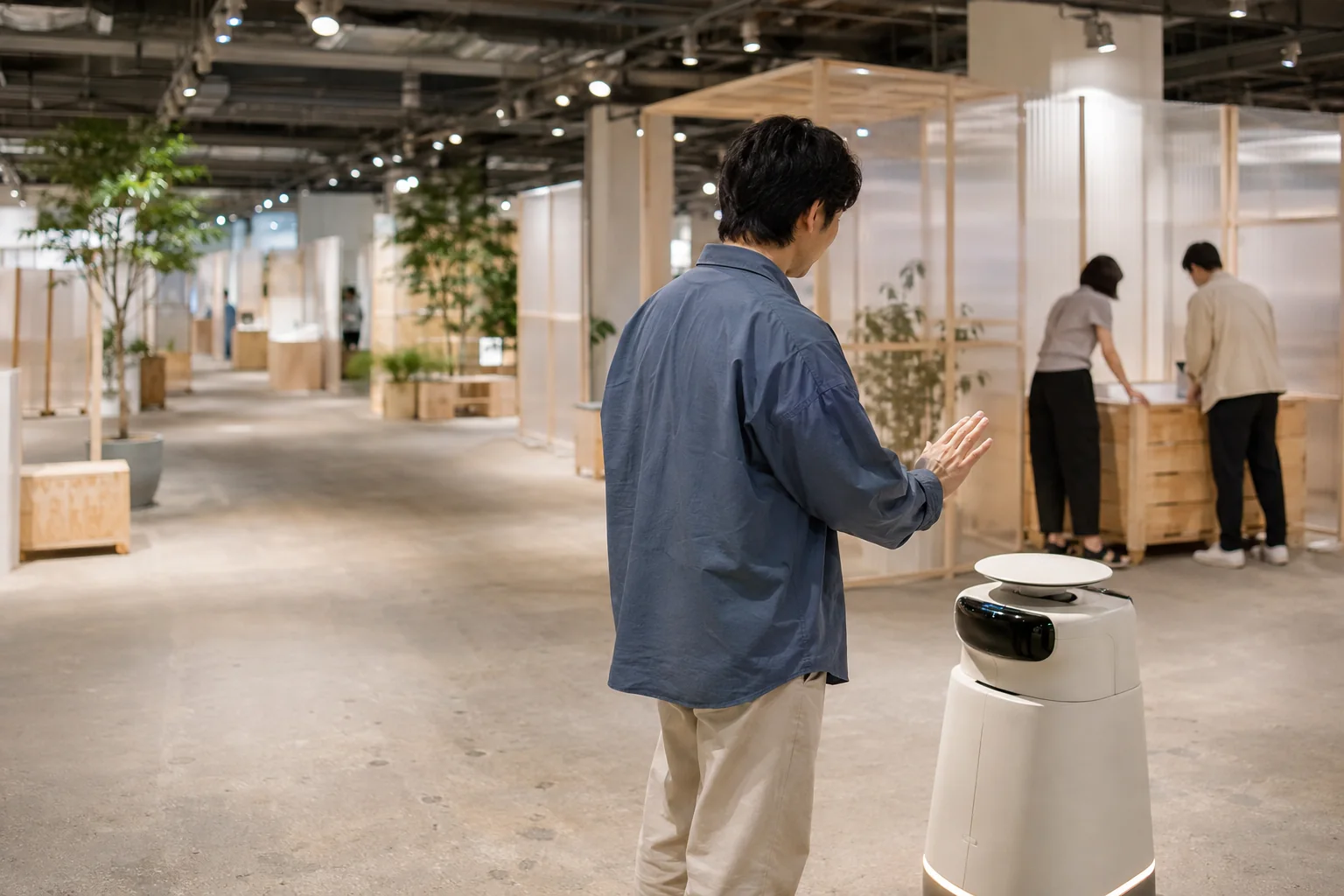
Disclosure: AI-generated editorial illustration; not documentary evidence of Smart Life Week 2026, COEX, Seoul AI programs, any robot capability, accessibility service, product, venue layout, participant, date, time, price, or registration condition.
License: Original SEOULIAN AI-generated editorial image