START HERE · Begin with the serving, not the English label
On a Korean menu, dotorimuk can lead you toward a plate of seasoned slices or a bowl with broth. The useful first question is not whether you like jelly. It is what kind of dish you want beside the rest of your meal.
Dotorimuk (도토리묵) is acorn-starch jelly. Korea Tourism Organization describes starch being combined with water, heated and cooled to set. Its food guide names both salad and a cold-broth serving with rice. That gives an English-speaking diner a better starting point than imagining a sweet course.
VERIFIED FACT · The jelly is an ingredient
The preparation transforms starch into a sliceable food; it is not a pile of chopped nuts. KTO describes a soft texture and a slight bitterness. Food writer Yoo Jeesang, writing in Morning Calm's September/October 2026 issue, also describes a restrained nutty character.
Those descriptions are useful expectations, not SEOULIAN tasting notes. The seasoning and serving format matter. Our suggestion is to notice the jelly separately from its sauce before deciding what you think of the whole dish.
VERIFIED FACT · Muchim brings vegetables and dressing
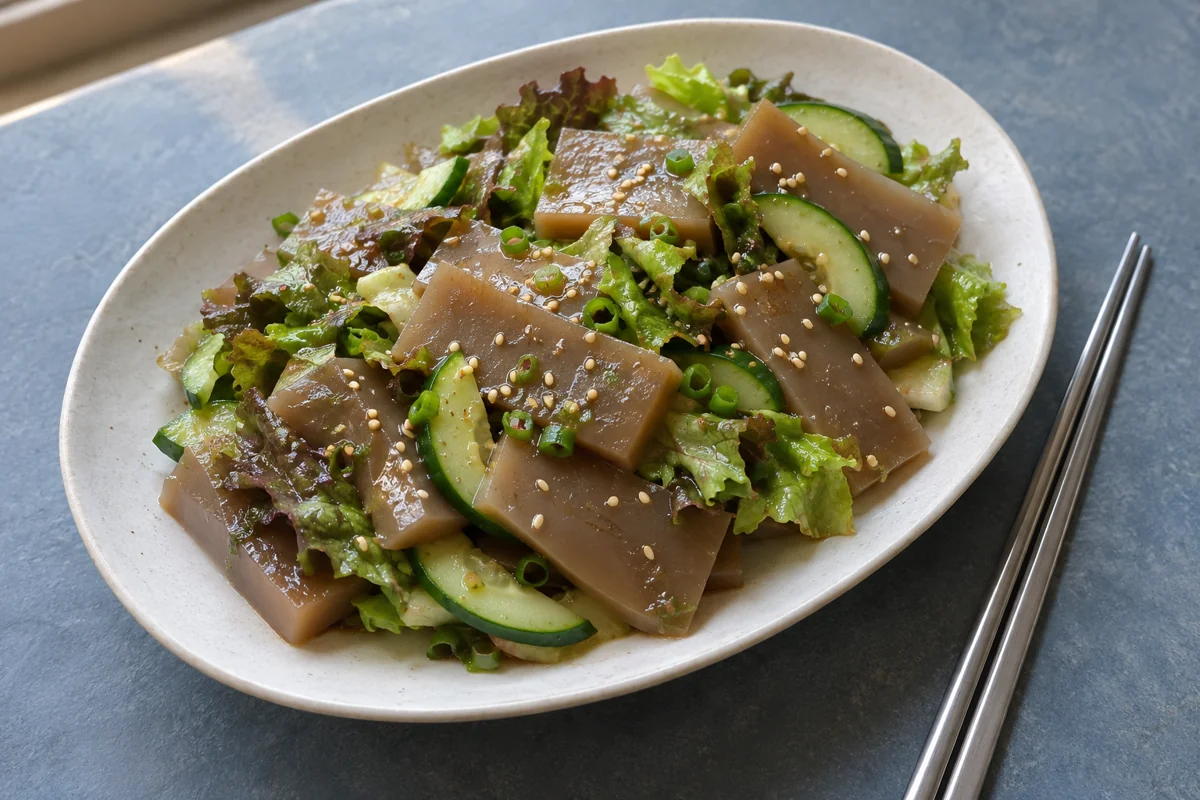
Dotorimuk-muchim (도토리묵무침) is the seasoned salad version. Maangchi's independently authored example combines the jelly with vegetables and a soy-based sauce that includes scallion, garlic, chili and sesame. It demonstrates one preparation, not a fixed specification for every restaurant.
Read the menu photograph and description together. Is the jelly the main part of the plate, or one component among abundant greens? If you prefer a gentler introduction, ask whether the dressing can come separately. That is a request, not a service every kitchen is guaranteed to offer.
VERIFIED FACT · A broth bowl is a different choice
Mukbap and muksabal are useful menu terms to investigate when you want a bowl rather than a dressed plate. KTO identifies a cold-broth-and-rice preparation; Morning Calm discusses both chilled and warm broth presentations. The sources show variety, not a rule that every bowl with one name arrives at one temperature.
Ask whether the bowl is cold or warm, what the broth contains, and whether rice is included or served separately. These details help you decide whether you are ordering a shared accompaniment or something to build your lunch around. Do not infer a complete ingredient list from the acorn name alone.
SEOULIAN INTERPRETATION · Make the first taste a small comparison
For a first encounter, choose one format. A shared salad lets the table try the jelly alongside another dish; a broth bowl makes the surrounding liquid part of the experience. Neither is the more authentic choice in this guide.
If the serving allows it, compare a piece carrying little dressing with one taken together with the vegetables or broth. Pay attention to how much of the flavor comes from each component. You do not need a specialist vocabulary: softer or firmer, mild or strongly seasoned, separate or combined will do.
Then save the full dish name, not just dotorimuk, for next time. That small distinction makes it easier to ask for the version you enjoyed—or deliberately try another. Source pages were checked on September 15, 2026. No restaurant visit, recipe test, universal price or dietary benefit is claimed.
THE SEOULIAN SIGNAL · EDITORIAL INTERPRETATION
Why this matters
Ask what happens around the jelly: is it dressed with vegetables or served in broth, and does rice come with it? The answer describes the meal more clearly than the word jelly alone.
SOURCE DESK · RESEARCH RECORDS
Research used for this analysis
- Acorn Jelly Salad (Dotorimuk) · October 19, 2023 Korea Tourism Organization · Primary public tourism food reference: starch-based preparation, broad texture, and salad/broth-with-rice formats. Weight-loss claims on the source page are not adopted.
- Seasoned acorn jelly (Dotorimuk-muchim) · updated June 24, 2023 Maangchi · Independent original cookery reference corroborates acorn starch and a seasoned vegetable-salad serving. Limited ingredient examples only; no quantities, cooking steps, personal anecdote, comments or media copied.
- The Forest's Oldest Feast, Acorns · September/October 2026 Yoo Jeesang · Morning Calm / Korean Air · Separately authored current travel-editorial feature corroborates the ingredient and the existence of cold and warm broth presentations. Limited factual cross-check, not adopted historical, nutritional, religious, exclusivity or restaurant-reception claims.
Original synthesis & image rights
Original SEOULIAN synthesis of limited food-identification facts from Korea Tourism Organization, independently authored Maangchi material and Yoo Jeesang's September/October 2026 Morning Calm feature. Three separately responsible sources; the airline magazine is travel editorial, not a nutrition authority or independent restaurant inspection. No recipe proportions, cooking sequence, source anecdotes, article wording, photographs or videos are reproduced. The ordering questions and tasting exercise are SEOULIAN editorial suggestions, not a firsthand review, dietary guarantee, recipe test or current stock/price claim. The unique built-in Imagegen cover is an AI-generated editorial illustration; not documentary evidence. Original PNG, optimized WebP, exact prompt and hashes are retained. Targets and reported usage remain attributed to the city and are not presented as independently verified outcomes.
Image disclosure
Credit: AI-generated editorial illustration; not documentary evidence. Fictional acorn-jelly salad, not a restaurant photograph or a tested recipe. SEOULIAN · Created with ChatGPT Image Generation.
Creator: SEOULIAN with ChatGPT Image Generation
Source type: SEOULIAN imagegen editorial photo
Disclosure: AI-generated editorial illustration; not documentary evidence. Fictional acorn-jelly salad, not a restaurant photograph or a tested recipe. SEOULIAN · Created with ChatGPT Image Generation.
License: Original SEOULIAN AI-generated editorial image