LOOK AGAIN · An outline is only the beginning
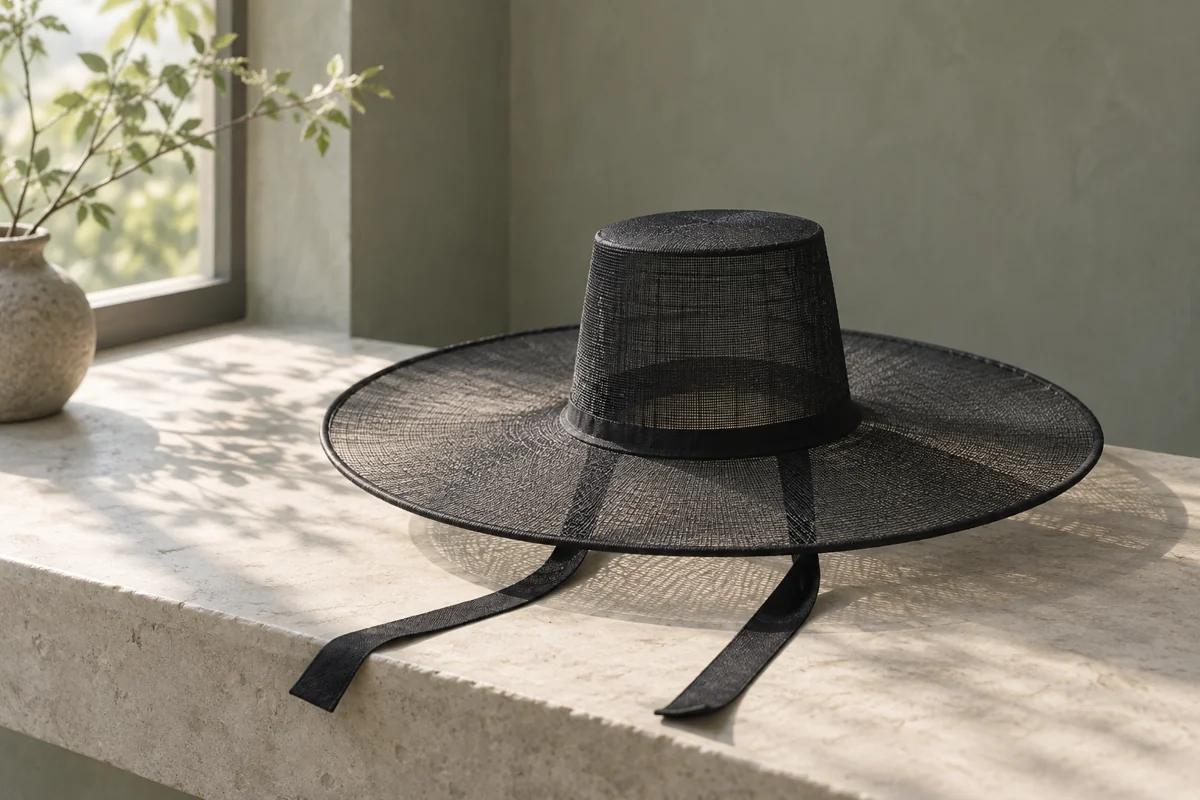
A black gat can register almost instantly: a broad brim, an upright crown, a pair of ties. Recognition is satisfying, but it can also end the looking too soon. Instead of asking only what the hat symbolizes, try asking where one part stops and another begins.
This guide concerns the familiar horsehair-crown form of the Korean gat, not every kind of historical Korean headwear. The useful discovery is structural. What seems like one continuous black shape brings together materials worked in different ways, followed by the skilled task of joining them.
VERIFIED CRAFT · Crown, brim, assembly
The World Crafts Council–Asia Pacific encyclopedia's entry, credited to the Korean Craft & Design Foundation with Hyeyoung Cho, describes gannil as gat-making. It identifies a bamboo brim, called yangtae, and a crown woven from horsehair. Silk and lacquer also belong to its account of the finished hat.
The distinction is not simply a shopping list of materials. In that account, fine bamboo strands are worked on a round support, while horsehair is woven around a cylindrical form. The components are then assembled. Crown-making, brim-making and completing the hat are separate parts of the craft, rather than a single piece pressed into shape.
SEOULIAN's suggestion is to trace that division visually. Find the brim's outer edge, follow it toward the center, then locate the junction below the crown. You do not need to name every tool to notice that two surfaces have been brought into one silhouette.
JEJU CONTEXT · The brim has its own history
Kang Shin-jae's 2019 Koreana report follows Jeju brim maker Jang Sun-ja and her daughter Yang Geum-mi. It describes brim weaving as a craft passed through women in the family, and recalls brims being sent from Jeju to mainland centers including Tongyeong and Yesan for assembly with crowns.
The report also explains that strand thickness changes across the brim: finer material near its inner edge and thicker strands farther out. It links this careful adjustment with an even-looking surface. We use the account as a dated record of craft knowledge, not as a current count of artisans or a statement about today's production arrangements.
Our reading: the broadest, flattest part of the hat deserves attention in its own right. It is not merely an accessory to the taller crown. A material that began as bamboo can become a surface delicate enough for light to pass through.
TRY IT · Compare structure before decoration
On the linked craft pages, first study the overall proportion. How high is the crown beside the breadth of the brim? Then look for the woven surface and the meeting of the parts. Finally, notice how the ties change the outline when they hang loose. These are observation prompts, not a method for dating or authenticating an object.
A photograph cannot establish every material, the maker, or whether an item is a handwoven example or a theatrical accessory. Use its own description. If a shop calls something gat-inspired, ask which aspect it borrows: proportion, translucency, weaving or simply the recognizable outline. A contemporary interpretation need not pretend to be an antique.
If you are interested in wearing or buying one, ask the maker or provider about fit, materials and handling. Do not infer rain resistance or durability from a dark finish. Appreciation can begin with a closer look; it does not require a purchase.
CONTINUE THE QUESTION · A Jeju reference point
Korea Tourism Organization identifies the Gat Exhibition Hall in Jocheon, Jeju, as a place devoted to the hats and their making. The hall also appears in Kang's dated account of the craft. That establishes a place to investigate, not a promise that a demonstration or hands-on session will be available when you arrive.
Start with the linked institutional pages, then confirm the current opening day, admission conditions and any demonstration directly before planning a trip. This is a craft-reading guide, not a live events calendar, booking offer or report of a visit.
Sources were checked on September 18, 2026 (UTC). The cover is an invented AI illustration, not one of the documented hats. The point to carry away is small but useful: separate the crown, the brim and the join, and the familiar outline becomes a record of several kinds of work.
THE SEOULIAN SIGNAL · EDITORIAL INTERPRETATION
Why this matters
SEOULIAN interpretation: looking at the meeting of brim and crown reveals more about a gat than treating its outline as a single costume symbol.
SOURCE DESK · RESEARCH RECORDS
Research used for this analysis
- KPop Demon Hunters: Culture & Travel · Jeju Gat Exhibition Hall subsection Korea Tourism Organization · Public-authority identification of the Jeju hat-making exhibition hall. Only the venue/craft subsection is used; no film, religious, popularity, operating-hours or merchandise claims adopted.
- Gannil (horsehair hat-making) Korean Craft & Design Foundation with Hyeyoung Cho · WCC–Asia Pacific · Attributed craft reference for materials, separately woven brim and crown, and assembly. No current artisan counts, step-by-step making instructions or photographs reproduced.
- Weaving Fine Bamboo Strands into Hat Brims · Autumn 2019 Kang Shin-jae · Korea Foundation, Koreana · Original reported account of Jeju brim-making, family transmission, mainland assembly, strand thickness and exhibition-hall context. Historical account remains explicitly dated; no current prices, artisan totals, long quotations or source images adopted.
Original synthesis & image rights
Original SEOULIAN English synthesis of linked factual sources, with editorial interpretation separately identified. No source prose, craft tutorial, photograph, film imagery or named maker's design reproduced. The unique built-in Imagegen cover is an invented illustration, not documentary evidence or an authenticated artifact. Targets and reported usage remain attributed to the city and are not presented as independently verified outcomes.
Image disclosure
Credit: SEOULIAN · Created with ChatGPT Image Generation.
Creator: SEOULIAN with ChatGPT Image Generation
Source type: SEOULIAN imagegen editorial photo
Disclosure: AI-generated editorial illustration; not documentary evidence. Invented gat still life, not a museum artifact, historical reconstruction, named maker's product or evidence of exact materials and construction.
License: Original SEOULIAN AI-generated editorial image