START HERE · Shop for a meal, not a photograph
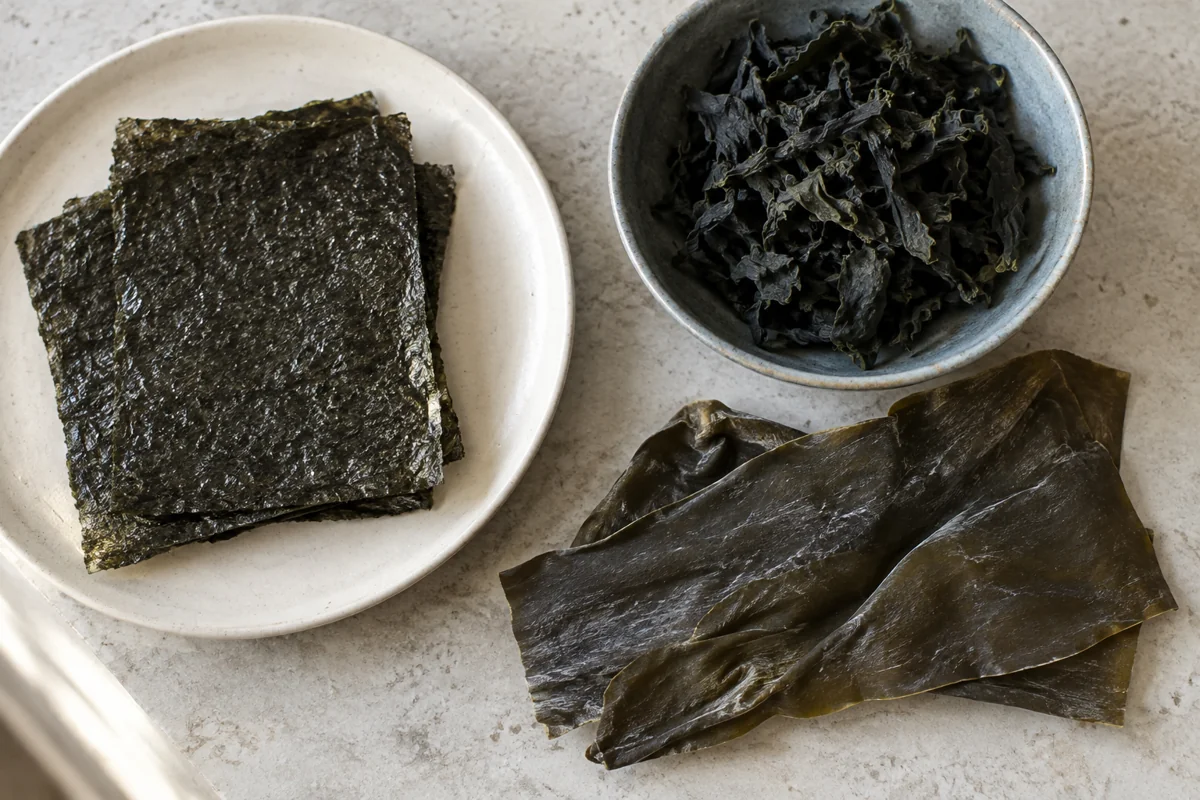
You want to make Korean seaweed soup, but the packet in your basket looks like the crisp sheets you have eaten with rice. Before buying a bigger bag, look for a more specific name. Gim, miyeok and dasima may all appear under the English word seaweed, but they are not one ingredient in three package sizes.
A useful first shopping list has two parts: the Korean word and what you want it to do. Wrap rice? Become the leafy ingredient in soup? Flavour a stock? Those questions make a crowded shelf easier to read without requiring a lesson in marine biology. The three uses below are starting points, not the limits of Korean cooking.
GIM · Look for the sheet, then check the seasoning
Gim (김) is laver. Korea Tourism Organization describes the familiar paper-like sheets used to wrap rice and make gimbap. It also distinguishes seasoned laver that has been oiled, toasted and salted. My Korean Kitchen's gim-gui guide separately describes roasted seaweed served beside rice.
For shopping, the distinction is more useful than the size of the bag. If you are making gimbap, choose the form and sheet size your recipe specifies; do not assume a small seasoned snack packet is the same product. If you want something to eat with rice immediately, read the preparation and ingredient information for that purpose. A plain sheet and a seasoned sheet can share the same basic name.
Our simplest serving suggestion is to try ready-to-eat gim beside plain cooked rice and notice what each bite contributes. There is no need to turn the first encounter into a rolling project.
MIYEOK · This is the seaweed in miyeok-guk
Miyeok (미역) is the ingredient to look for when making miyeok-guk, Korean seaweed soup. Korean Bapsang's guide uses dried miyeok, rehydrated before cooking, and notes that packages come in different sizes and preparations, including pre-cut versions. The important change is from a compact dry ingredient to softened seaweed, not from a crisp snack to a broth garnish.
Keep the package instructions: preparation times can differ. Measure the dry amount called for by your chosen recipe, rather than trying to fill a soup bowl with dry seaweed. If you are buying ingredients for someone else's cooking, send them the Korean name and package description before choosing a substitute.
The practical question here is, 'Is this the miyeok my soup recipe calls for?' That is more precise than asking whether a packet contains something green from the sea.
DASIMA · Think about the liquid it helps make
Dasima (다시마) is kelp, also sold as kombu. Korean Bapsang's vegetable-stock guide uses dried dasima to build a savoury base for soups and stews. That is a different starting job from wrapping rice or providing the leafy body of miyeok soup.
If your recipe calls for dried kelp for stock, match that description rather than buying whichever seaweed packet is closest. Follow the recipe's method and the maker's instructions; this guide does not prescribe one cooking time for every product. The point is to know why the ingredient is in your basket before deciding how to use it.
TAKE IT WITH YOU · Three checks before checkout
First, match the name to the dish. Second, check the preparation: plain or seasoned, dried or ready to eat, whole sheets or cut pieces. Third, read the full ingredient list if oils, seasonings or other additions matter to you. The front photograph is an invitation to look, not a complete specification.
Buy for one meal you actually want to make. Afterward, save the name and one thing you noticed about its role in that meal. A familiar word on the next shopping trip is a small but satisfying kind of fluency.
THE SEOULIAN SIGNAL · EDITORIAL INTERPRETATION
Why this matters
Save the Korean ingredient name with its job: 김 for the gim a rice-wrap recipe specifies, 미역 for miyeok soup, 다시마 for a kelp-based stock. Then check whether the particular package is plain, seasoned, dried or ready to eat.
SOURCE DESK · RESEARCH RECORDS
Research used for this analysis
- Laver: The Pioneering K-Food Captivating the World · February 20, 2025; checked September 15, 2026 Korea Tourism Organization · VISITKOREA · Primary public tourism food description: gim/laver sheets, rice wrapping, gimbap and seasoned laver. Narrow factual synthesis only; historical legends, production statistics, health and popularity claims, recipes and source imagery are not used.
- Easy Roasted Seaweed Recipe · updated December 7, 2024; checked September 15, 2026 My Korean Kitchen · Sue Pressey · Independent cooking guide corroborates roasted gim as a side dish with rice and discusses differing seaweed preparations. No recipe quantities or method, television claims, product rankings, quoted judgments, prices, source prose or images copied.
- Miyeok Guk (Beef Seaweed Soup) · updated April 21, 2021; checked September 15, 2026 Korean Bapsang · Hyosun · Independent original cooking guide: dried miyeok for soup, rehydration and product/pre-cut differences; package-specific preparation. No medical/postpartum claims, recipe formula or complete method copied.
- Vegetable Broth for Korean Cooking · updated January 18, 2024; checked September 15, 2026 Korean Bapsang · Hyosun · Cook-author's account identifies dried kelp as dasima/kombu and explains its broth role. Counts as the same organization as the miyeok page, not a fourth independent source. No complete recipe, religious context, nutritional assertions, source images, shelf-life or safety claims adopted.
Original synthesis & image rights
Original SEOULIAN synthesis of limited culinary facts from Korea Tourism Organization, My Korean Kitchen and Korean Bapsang. The shopping framework and suggested comparison are SEOULIAN editorial guidance, not a firsthand product test. No source prose, recipe quantities or complete methods, photographs, packaging or comments by readers are reproduced. Nutrition promises, origin legends, sales rankings and unverified prices are excluded. The unique built-in Imagegen cover is an AI-generated editorial illustration; not documentary evidence or a scientific identification chart. Original PNG, optimized WebP, exact prompt and hashes are recorded in the image manifest. Targets and reported usage remain attributed to the city and are not presented as independently verified outcomes.
Image disclosure
Credit: AI-generated editorial illustration; not documentary evidence. A fictional ingredient comparison, not a product photograph or scientific identification chart. SEOULIAN · Created with ChatGPT Image Generation.
Creator: SEOULIAN with ChatGPT Image Generation
Source type: SEOULIAN imagegen editorial photo
Disclosure: AI-generated editorial illustration; not documentary evidence. A fictional ingredient comparison, not a product photograph or scientific identification chart. SEOULIAN · Created with ChatGPT Image Generation.
License: Original SEOULIAN AI-generated editorial image