START HERE · The ingredient you may not see
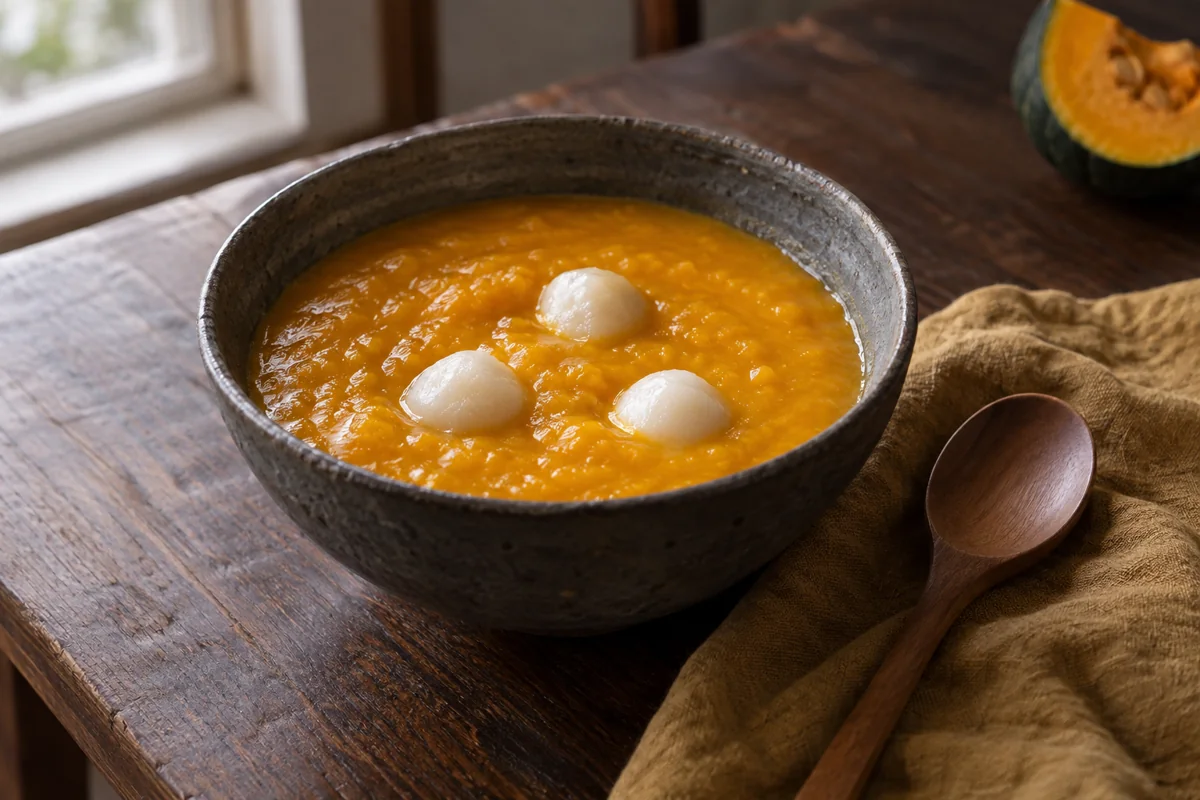
A bowl of hobakjuk can raise a reasonable question: if it looks like blended pumpkin, why is it called porridge? The useful clue is rice. Korea Tourism Organization's food entry describes cooked pumpkin combined with sweet rice flour. The pumpkin supplies the obvious identity; rice helps explain the dish behind that golden surface.
For a first encounter, do not begin by deciding whether the bowl belongs before dinner or after it. Begin with a smaller question: what kind of texture, sweetness and portion are you looking for? That gives you something useful to ask when a photograph is all the menu offers.
THE NAME · Pumpkin is a starting point
Hobakjuk (호박죽) is pumpkin porridge. The word hobak covers different pumpkins and squash, so it does not identify one compulsory variety. Korean Bapsang's Hyosun describes both mature pumpkin, neulgeun hobak, and danhobak, the squash commonly called kabocha in the United States.
That distinction is useful when you save a recipe or shop for ingredients. Keep the squash name as well as the dish name. An English label that says only pumpkin does not tell you exactly which version a cook has in mind.
THE RICE · Body, small bites, or both
The rice is chapssal (찹쌀), also called sweet or glutinous rice. Korean Bapsang documents finely ground soaked rice or a sweet-rice-flour slurry incorporated into the porridge, as well as small rice balls called saealsim (새알심). Some versions use both.
My Korean Kitchen's Sue Pressey separately uses rice flour to thicken the pumpkin base and treats the rice balls as optional. They offer a distinct bite within the softer porridge. If the little white rounds caught your attention in a photograph, ask whether they are included in the bowl you are actually ordering.
Their absence is not, by itself, a sign that something is missing. The two cooking accounts make room for variation; a garnish is not a checklist for judging every bowl.
ON A MENU · Ask about this serving
Korea Tourism Organization describes appetizer and dessert roles, while My Korean Kitchen discusses snack, dessert and breakfast uses. Those descriptions explain why the same dish name need not promise the same place in a meal. They are not a guarantee about any particular restaurant's portion.
Sweetness also deserves a question. Sue's recipe allows the added sugar to be adjusted, illustrating why the name alone cannot tell you how sweet a serving will be. Ask how that kitchen prepares it; do not assume a requested adjustment is available.
If you are choosing a packaged version, read its own ingredient list, portion information and preparation directions. The food name is an introduction, not the complete product description.
TRY IT · Give one bowl your attention
Our suggestion is to choose a serving that fits the moment you have: a small introduction alongside a meal, or a bowl you want to make the focus. Confirm the size, sweetness and rice-ball option before ordering. Those three questions do more work than trying to identify a single definitive version from pictures.
When you eat it, notice the relationship between the pumpkin and the rice rather than searching for a verdict on authenticity. Save the name of the version you enjoyed. The next menu then begins with recognition, and perhaps one new question.
THE SEOULIAN SIGNAL · EDITORIAL INTERPRETATION
Why this matters
Save 호박죽 with three questions: How large is the serving? How sweet is this version? Does it include 새알심, the small rice balls? A photograph cannot answer all three.
SOURCE DESK · RESEARCH RECORDS
Research used for this analysis
- Pumpkin Porridge (호박죽 / Hobakjuk) · October 19, 2023; checked September 15, 2026 Korea Tourism Organization · VISITKOREA · Official food entry: pumpkin with sweet rice flour, dish name, appetizer/dessert roles. Only limited culinary facts used; popularity and recovery claims, source wording and imagery excluded.
- Hobakjuk (Pumpkin Porridge) · updated January 10, 2021; checked September 15, 2026 Korean Bapsang · Hyosun · Independent original cook-author account: squash names, chapssal, ground-rice/flour and saealsim options. No recipe formula, full method, photography, nutrition or national-preference assertion reproduced.
- Korean Pumpkin Porridge (Hobakjuk) · updated May 13, 2019; checked September 15, 2026 My Korean Kitchen · Sue Pressey · Separate original cook-author account corroborates rice-flour thickening, optional rice balls and varied serving roles; one recipe's adjustable sugar is not generalized to every restaurant. No quantities, full method, health claims, storage advice, source images or prose copied.
Original synthesis & image rights
Original SEOULIAN synthesis of limited culinary facts from Korea Tourism Organization, Korean Bapsang and My Korean Kitchen. The menu-reading framework and suggested questions are SEOULIAN editorial guidance, not firsthand tasting or a tested recipe. No source prose, recipe quantities or complete methods, photographs, comments, artwork or packaging are reproduced. Medical claims, population-wide preferences, origin legends and unverified prices are excluded. The unique built-in Imagegen cover is an AI-generated editorial illustration; not documentary evidence of a restaurant, recipe or actual meal. Original PNG, optimized WebP, exact prompt and hashes are recorded in the image manifest. Targets and reported usage remain attributed to the city and are not presented as independently verified outcomes.
Image disclosure
Credit: AI-generated editorial illustration; not documentary evidence. A fictional bowl of hobakjuk, not a restaurant photograph, tested recipe or documented meal. SEOULIAN · Created with ChatGPT Image Generation.
Creator: SEOULIAN with ChatGPT Image Generation
Source type: SEOULIAN imagegen editorial photo
Disclosure: AI-generated editorial illustration; not documentary evidence. A fictional bowl of hobakjuk, not a restaurant photograph, tested recipe or documented meal. SEOULIAN · Created with ChatGPT Image Generation.
License: Original SEOULIAN AI-generated editorial image