SEOULIAN INTERPRETATION · A picture with a surface in front of it
When a brightly decorated Korean object catches your eye, the first question is usually what the picture represents. With hwagak (화각), try a different question: which side of the material carries the paint? The answer makes the surface more interesting before you identify a single flower or animal.
Hwagak uses thin sheets of ox horn decorated from the reverse. The color is viewed through the material, rather than simply painted onto the outward face of a wooden object. It is a small change in how you imagine the layers, but a useful doorway into a craft that can otherwise disappear behind the general description of colorful furniture.
VERIFIED CONTEXT · Horn, painting, wood
Seoul Museum of Craft Art describes a hwagak box made by attaching small, reverse-painted horn sheets to wood. Its record also identifies narrow animal-bone strips placed between the sheets. The National Museum of Korea independently explains the same basic layering in its account of another box: horn is flattened into thin, translucent sheets, decorated on one side, then attached with the painted side facing the wood.
For a viewer, this separates three things that can initially look like one: the support, the picture and the layer through which the picture is seen. You do not need to know the full workshop process to hold those three parts in mind. This is an introduction to looking, not instructions for preparing horn or working with lacquer.
The joins are worth noticing, too. On the Seoul museum's box, the lines between individual pieces are part of the construction. Follow a boundary before following a motif. Does the image occupy one small area, or does your eye connect it to the neighboring area? That question is our suggested exercise, not a claim that every hwagak object uses identical joinery.
THREE OBJECTS · A box is only the beginning
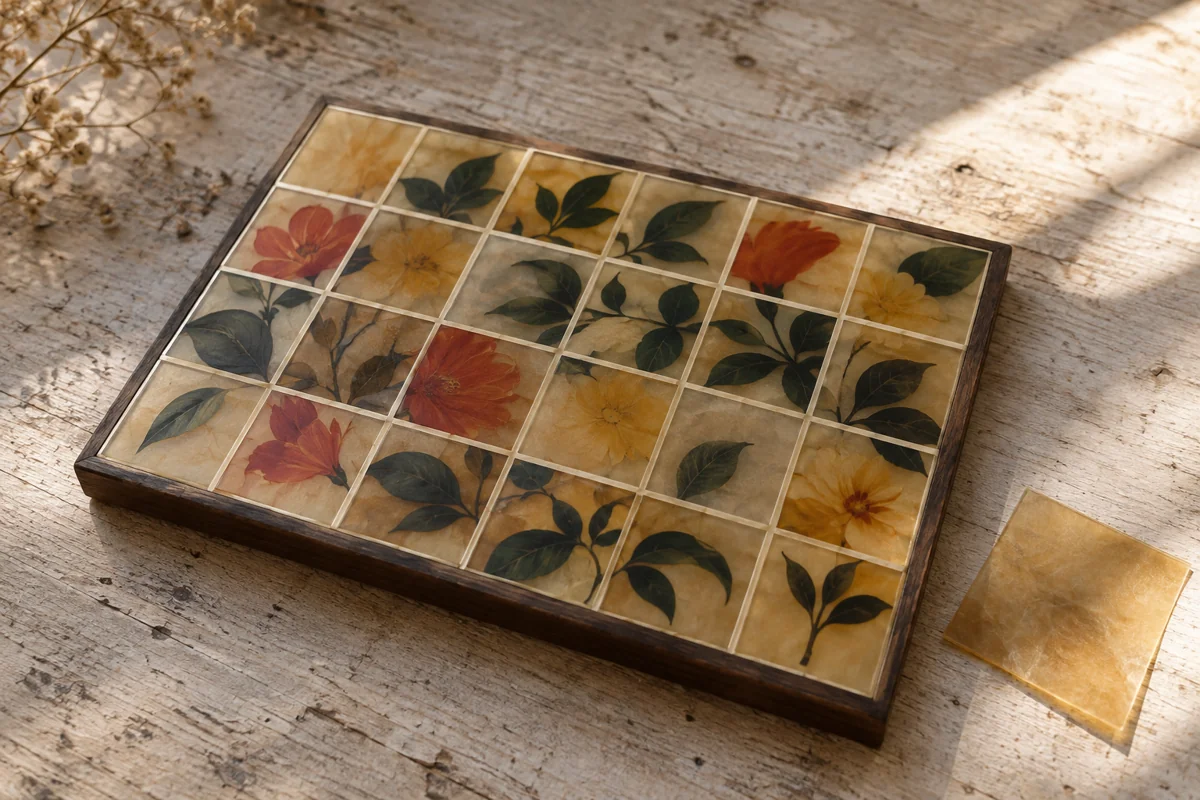
Start with the Seoul museum's box, catalogued as CR-AP-00-000319. Its record places it in the Joseon period and describes plant and animal decoration. Use the museum's own images at the source link to compare a broad view with details; our cover is an invented illustration, not that collection object.
Next, open Ewha Womans University Museum's record for a four-tier cabinet. The museum dates it to the early twentieth century and identifies paulownia and wild-walnut wood. Its description emphasizes symmetrical arrangements across the tiers. The change in scale gives you a different question: how does the decoration organize a tall piece of furniture rather than a small container?
Finally, open the National Museum of Korea's record for a hwagak sewing ruler, catalogued as 수정386. The museum explains its use in clothing-making and sewing and records a length of 53.3 centimeters and a width of 1.7 centimeters. Compare that long, narrow format with the cabinet. A measuring implement makes the point especially clearly: this technique was not confined to imposing furniture.
TRY IT ONLINE · Compare size before symbolism
Open the three records in separate tabs. First compare the objects' overall shapes. Then look for divisions in the decorated surfaces. Only after that, choose one motif to investigate through its own museum description. The exercise takes no specialist vocabulary, and you can stop after one comparison instead of trying to decode every detail.
Keep the distinction between a collection and an exhibition in view. These sources were checked on September 18, 2026 (UTC), but collection records are not a promise of access to particular objects on the day you visit. Check current museum information before planning a trip around one work. You can make the comparisons in this guide entirely online.
If this introduction sends you toward a shop, the useful next step is a question, not a visual verdict. Ask for the object's stated materials and maker information; a pattern or photograph cannot establish them. For now, there is plenty to discover simply by noticing that, in hwagak, the picture and the surface you see first are not quite the same thing.
THE SEOULIAN SIGNAL · EDITORIAL INTERPRETATION
Why this matters
Ask where the paint is, not only what the picture shows. Then compare how small decorated sheets cover objects of very different sizes.
SOURCE DESK · RESEARCH RECORDS
Research used for this analysis
- Hwagak box — 화각함, CR-AP-00-000319 Seoul Museum of Craft Art · Primary collection record: reverse-painted horn sheets applied to wood, bone strips at joins, object identification and Joseon classification. Checked September 18, 2026 UTC. No claim about current display. KOGL Type 4 images are not reused; facts independently synthesized, not translated text.
- Ox-horn Plated Hwagak Box — Bongwan8962 National Museum of Korea · Independent primary collection record: thin translucent horn sheets with the painted side attached to a wooden surface. Checked September 18, 2026 UTC. No religious interpretation, historical popularity claim or museum image reused.
- Four-tier Cabinet with Painted Ox-horn Sheets Ewha Womans University Museum · Independent primary collection record: early twentieth-century date, paulownia and wild-walnut wood, painted horn and symmetrical tier arrangement. Checked September 18, 2026 UTC. No exhibition-status inference or image reuse.
- Hwagak sewing ruler — 바느질 화각 자, 수정386 National Museum of Korea · Primary collection record: ruler identity, clothing-making/sewing use, 53.3 cm length and 1.7 cm width. Checked September 18, 2026 UTC. Same publisher as the box record, not counted as an additional independent institution. Exact manufacture date is uncertain and omitted; no image reused or current-display guarantee.
Original synthesis & image rights
Original SEOULIAN English synthesis, not a translation, craft tutorial, first-person museum visit or product authentication. Museum records support the facts; their photographs, object designs and wording are not reproduced. The invented cover was made with built-in ChatGPT Image Generation. AI-generated editorial illustration; not documentary evidence. Targets and reported usage remain attributed to the city and are not presented as independently verified outcomes.
Image disclosure
Credit: SEOULIAN · Created with ChatGPT Image Generation.
Creator: SEOULIAN with ChatGPT Image Generation
Source type: SEOULIAN imagegen editorial photo
Disclosure: AI-generated editorial illustration; not documentary evidence. Invented hwagak-inspired panel and material still life, not a museum artifact, named artisan work or workshop record.
License: Original SEOULIAN AI-generated editorial image