SEOULIAN INTERPRETATION · Start at the edge
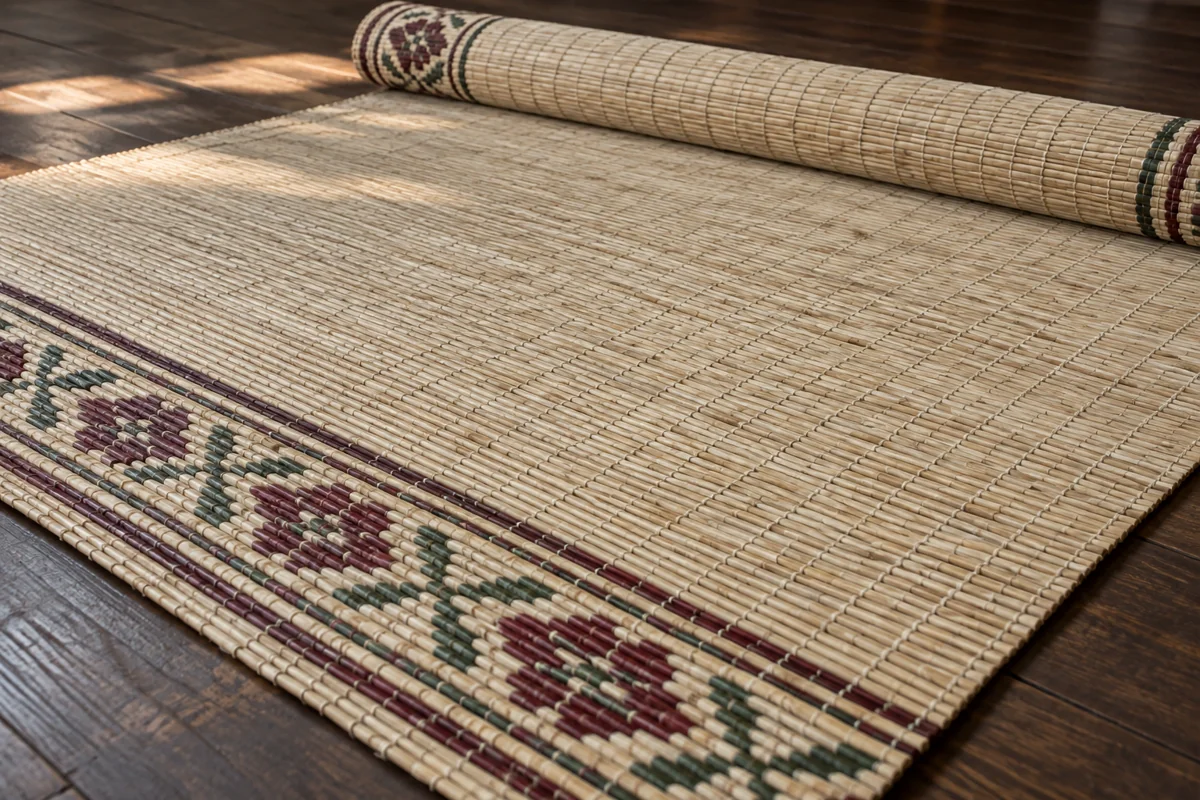
A flower on a mat can invite you to look at its color. A more revealing question is how that color got there. In hwamunseok (화문석), associated with Ganghwa Island in Incheon, the pattern is made with the material being woven. It is a useful introduction to Korean design because the decoration and the construction can be read together.
Try looking from the plain area toward the border. Follow one line of material until it meets a colored section. This is SEOULIAN's suggested looking exercise, not an authenticity test: a photograph or an attractive motif cannot tell you everything about the maker or the object.
VERIFIED CONTEXT · A plant becomes a patterned surface
The Korea Tourism Organization explains the name as a flower-patterned mat and identifies the material as wanggol, a plant cultivated on Ganghwa. Its account describes dyed material woven by hand and connects the mat with floor-sitting and the maru, a wooden-floored space in a Korean home.
Koreana, published by the Korea Foundation, adds the preparation behind the finished surface. Its summer 2023 feature describes stems being softened and dried, colored when needed, and sorted before weaving. It distinguishes large mats made with a weighted weaving apparatus from smaller objects worked by hand. Handmade does not necessarily mean made without tools.
That sequence changes what there is to appreciate. The finished pattern also depends on preparation and controlled joining, not only on a picture imagined at the end. Look for the relationship between repeated strands and a larger shape; you do not need to identify every motif to enjoy the work.
BEYOND THE FLOOR · One material, different objects
KTO also documents wanggol objects such as coasters, baskets and cushions. These belong to the wider craft family; calling every woven container a hwamunseok would lose the distinction between a mat and other forms.
The Koreana feature profiles Hur Sung-ja's experiments with sedge craft, including work developed with designers. It provides a dated example of a practitioner changing forms and uses rather than simply repeating a fixed decorative vocabulary. This is a reference to that published account, not a claim about her current stock, commissions or exhibitions.
For a newcomer, scale offers a useful comparison. Ask what changes when a flat surface becomes the side of a basket. Notice the edge, the curve and the point where the pattern turns. Those questions keep attention on making rather than treating traditional craft as a single visual style.
TRY IT · Look first, then ask specific questions
Incheon Tourism's account of the Hwamunseok Cultural Center on Ganghwa describes displays about plant cultivation, processing, mat-making and the craft's history. It is a starting point for learning the stages behind the object. Use the linked listing to find the center, then confirm the day's access and any workshop arrangements before traveling; this article does not confirm a class booking or opening schedule.
If you are considering a purchase, ask what plant material is used, who made it, where it was made and how to care for that particular piece. Measure the space where you plan to use it. Ask about packing before assuming a mat can be folded or a basket squeezed into luggage. These are buying questions, not assurances about any seller.
Sources were checked on September 18, 2026 (UTC). Older shopping prices and claims about temperature or humidity performance are not adopted here. The invitation is simpler: understand a little more of the object before deciding whether it belongs in your home.
THE SEOULIAN SIGNAL · EDITORIAL INTERPRETATION
Why this matters
Look at how the colored material joins the plain weave, then ask who made the object and what it is made from. A pattern alone cannot establish provenance.
SOURCE DESK · RESEARCH RECORDS
Research used for this analysis
- Ganghwado Hwamunseok Mat — Shopping Like a Local Korea Tourism Organization · Official material reference: name, wanggol, dyed woven patterns, floor use and related small objects. Page carries a December 31, 2023 information-date caveat; checked September 18, 2026 UTC. Prices, current availability and performance claims not used; no media reused.
- Weaving the New from the Old — Lee Gi-sook, Summer 2023 Korea Foundation · Koreana · Independent authored artisan feature: stem preparation, large-mat tools versus smaller handworked forms, and Hur Sung-ja's design collaborations as a dated example. Checked September 18, 2026 UTC. No quotations, weaving instructions, photographs or artist designs reproduced.
- Hwamunseok Cultural Center — 화문석문화관 Incheon Metropolitan City · Incheon Tourism Organization · Regional tourism account, marked revised April 16, 2026: colored wanggol mat and center displays on cultivation, processing, production and history. Checked September 18, 2026 UTC. No opening-time, fee, booking or transport guarantee; no photographs or text reused.
Original synthesis & image rights
Original SEOULIAN English synthesis, not a translation, copied craft tutorial, product test or first-person visit. Linked sources support material and cultural facts; their photographs, designs and wording are not reproduced. The cover is an invented conceptual mat created with built-in ChatGPT Image Generation, not a named artisan's work or sale listing. AI-generated editorial illustration; not documentary evidence. Targets and reported usage remain attributed to the city and are not presented as independently verified outcomes.
Image disclosure
Credit: SEOULIAN · Created with ChatGPT Image Generation.
Creator: SEOULIAN with ChatGPT Image Generation
Source type: SEOULIAN imagegen editorial photo
Disclosure: AI-generated editorial illustration; not documentary evidence. An invented mat inspired by woven plant-fiber craft, not a named artisan's work, authenticated antique, product listing or source photograph.
License: Original SEOULIAN AI-generated editorial image