FIRST LOOK · Find the waist, then look beyond it
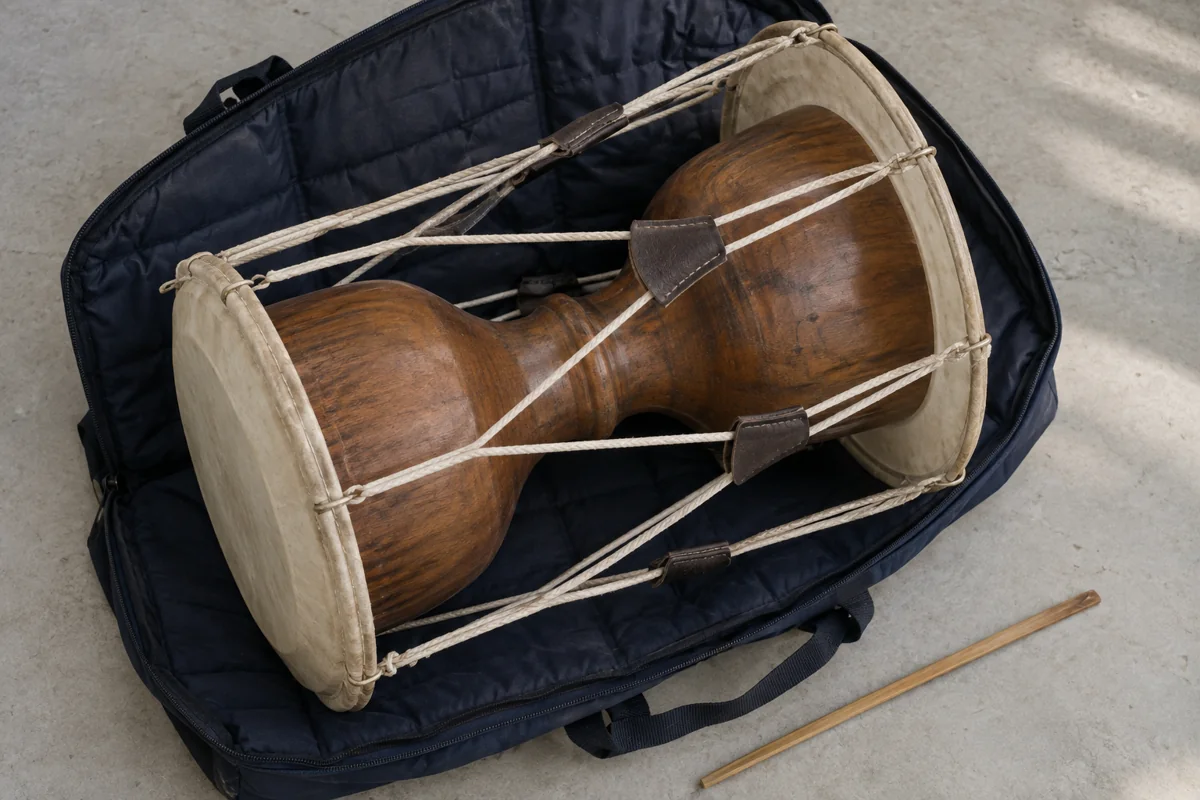
You do not need to recognize every instrument on a Korean stage to find a place to begin listening. Look for the drum with a narrow middle and a broad head at each end. That is the janggu, written 장구; museum labels may also call it janggo. Its shape gives you a useful first question: why does one player need two striking surfaces?
Seoul's official introduction to traditional instruments places the janggu among percussion instruments and describes a bamboo stick in the right hand with the bare left hand at the other end. Keep that image in mind, but do not mistake it for the only way the instrument can be played.
VERIFIED CONTEXT · Two heads are not two copies
The National Gugak Center's instrument encyclopedia distinguishes the bukpyeon, also called gungpyeon, from the chaepyeon. It explains that the former generally uses thicker skin and has a slightly larger diameter to produce a lower sound. These are useful tendencies, not a promise that every janggu has identical dimensions or tuning.
The cords across the body are functional. The center explains that moving the tensioning pieces changes the tension of the skins and helps adjust the sound. What looks like part of the drum's visual pattern also belongs to its working mechanism.
SEOULIAN's suggestion is to listen for contrast rather than hunt for two fixed musical notes. Which strokes feel weightier? Which arrive with a sharper edge? Give yourself ordinary descriptive words before worrying about specialist vocabulary.
WATCH THE PLAYER · One hand or two sticks?
The National Gugak Center's English instrument exhibition distinguishes a stick-and-hand approach in court or classical music from two-stick playing in folk music and janggu dance. Its encyclopedia documents differences by musical use and region, including moving performances with a beater in each hand.
That variation is the important point for a newcomer. A performer standing with two beaters is not necessarily using a different instrument from the seated player you saw earlier. Before comparing speed or loudness, notice how the drum is supported and what touches each head.
This is not a playing lesson. Do not copy a grip, tighten a borrowed drum or test a museum instrument from an illustration. In a class, ask the teacher to identify the two sides and demonstrate the approach used for that particular music.
TRY LISTENING · Three passes through one short passage
Our proposed exercise starts with an official performance or instrument demonstration that credits its performers. On the first pass, watch only the player's hands or beaters. Try to connect a visible movement with a sound, without attempting to count everything.
On the second pass, listen without watching. Can you still pick out contrasting attacks? If not, choose a clearer recording or a less crowded passage. An unfamiliar sound is not a test you have failed, and a dense ensemble can make individual details difficult to separate.
On the third pass, widen your attention to the other musicians. Ask where the drum draws your ear and where you stop noticing it. You need not identify a named rhythm to notice a relationship. Save the performance title and artist credit so the next listen starts with a real reference, not just a vague memory of Korean drumming.
KEEP THE CONTEXT · One instrument, more than one setting
Korea Tourism Organization's introduction to pungmulnori places the janggu alongside barrel drum, gongs and a wind instrument in a moving ensemble. That gives you another listening setting to explore, not a rule that every appearance of a janggu is a pungmul performance. Its linked holiday guide is dated 2025; no event dates from that page are presented here as current. This article does not announce a performance, class, price or opening schedule.
Facts and source access were checked on September 20, 2026 (UTC). The cover is an AI-generated editorial illustration, not a photograph of a particular musician's drum. For the first listen, the simplest takeaway is enough: recognize the narrow waist, then give the two ends your attention.
THE SEOULIAN SIGNAL · EDITORIAL INTERPRETATION
Why this matters
SEOULIAN interpretation: follow the contrast between the two ends before trying to name a rhythmic pattern. Watching the player's tools helps explain why one drum can offer several kinds of attack.
SOURCE DESK · RESEARCH RECORDS
Research used for this analysis
- Traditional Culture · Traditional Musical Instruments Seoul Metropolitan Government · Official introduction to janggu as a double-headed percussion instrument and a stick-and-hand playing approach. No unrelated historical, seasonal or religious material adopted. This introductory method is not treated as universal.
- Gugak Encyclopedia · 장구 (Janggu) National Gugak Center · Specialist primary reference for drumhead names, general skin/size differences, tension adjustment and variations in playing. Factual research only: no translation of passages, notation, media or craft instructions. Text is KOGL Type 2 and multimedia Type 4; these are not commercial reuse permissions for source expression.
- Korea Traditional Musical Instruments · Janggu National Gugak Center · Google Arts & Culture · English specialist explanation of stick-and-hand versus two-stick techniques. Same institution as the encyclopedia, not a separate independent source. No images or performance media reproduced.
- Traditional Korean Holiday of Bountiful Harvest, Chuseok · September 11, 2025 Korea Tourism Organization · Independent tourism context identifying janggu within the pungmulnori ensemble. Historical publication used only for stable instrument context, not holiday dates, current events, prices, religious material or images.
Original synthesis & image rights
Original SEOULIAN English synthesis of linked factual sources, not a translation or adaptation of their prose. The listening exercise is our editorial suggestion. No source photographs, audio, notation or video are reproduced. National Gugak Center text and multimedia carry restricted reuse terms; only independently expressed factual research is used here. The unique built-in Imagegen cover is an invented editorial illustration, not documentary evidence or an exact instrument diagram. Targets and reported usage remain attributed to the city and are not presented as independently verified outcomes.
Image disclosure
Credit: SEOULIAN · Created with ChatGPT Image Generation.
Creator: SEOULIAN with ChatGPT Image Generation
Source type: SEOULIAN imagegen editorial photo
Disclosure: AI-generated editorial illustration; not documentary evidence. Invented generic janggu arrangement, not a museum object, a named performer's instrument or an exact construction diagram.
License: Original SEOULIAN AI-generated editorial image