START BELOW THE CANOPY
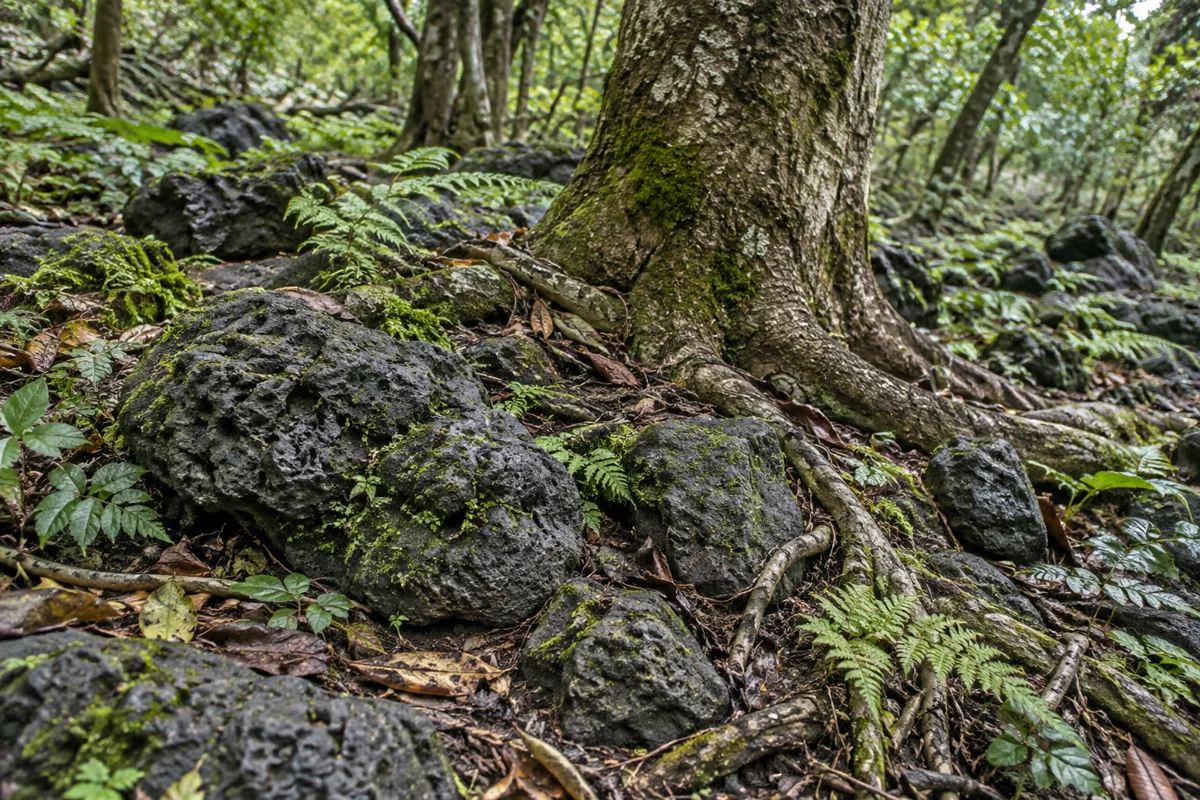
A forest visit often begins with looking up. In Jeju's gotjawal, try beginning with the space around a tree's base. Where does the root go? What lies between the stones? Which parts of the ground disappear beneath leaves? Those small questions give a first-time visitor something more useful to do than search for the most dramatic green photograph.
Gotjawal, 곶자왈, refers to Jeju woodland associated with lava terrain. Korea Tourism Organization's Hwansang Gotjawal Forest listing draws attention to the rocky setting, ferns and exposed roots. Jeju Tourism Organization likewise describes trees, vines and rocks together. The ground is part of the subject, not a background that can be cropped away.
VERIFIED CONTEXT · Rock does not mean no soil
A 2013 study in the Journal of Marine and Island Cultures gives that impression a useful qualification. Investigating western Jeju's Hankyeong-Andeok terrain, Hong-Gu Kang, Chan-Soo Kim and Eun-Shik Kim described poorly developed, shallow soil among rocky blocks. A stone-filled forest floor should not be simplified into the claim that its trees live without soil.
Our looking exercise is deliberately modest. From the permitted path, choose one patch where a root, a stone and fallen leaves meet. Trace their boundaries with your eyes, then look at a nearby patch. Compare the shapes and gaps without turning over rocks, pulling plants or leaving the route. You do not need a species list to notice relationships.
A photograph can help you remember a question, but it cannot answer everything in it. A visible root does not tell you the tree's age. A dark hollow does not reveal what lives inside. Keep those unknowns in the picture instead of giving every feature an instant explanation.
TWO HISTORIES · The rock and the trees
The same researchers used tree rings and resident interviews to investigate forest history. Their study sites showed regrowth after earlier wood use declined, with regeneration dating to the late 1960s and, in one vegetation group, the mid-1970s. This is a finding about surveyed western sites, not an age assigned to every tree or every gotjawal attraction.
SEOULIAN's interpretation: the age of the terrain and the history of the vegetation are different questions. A forest can look dense and weathered without being unchanged through time. Ask a guide about both the landscape beneath the trees and the ways people have used it; neither question needs to diminish the pleasure of being there.
BEFORE YOU GO · Save the whole place name
Gotjawal is not one interchangeable destination. KTO lists Hwansang Gotjawal Forest at 594-1 Nokchabunjae-ro in Jeju-si. Jeju Tourism Organization lists Jeju Gotjawal Provincial Park at 178 Educity-ro, Daejeong-eup, Seogwipo-si. They are separate destinations; do not attach one site's ticket or tour information to the other's map pin.
For the provincial park, Visit Jeju warns that most paths are unpaved and advises suitable footwear, long sleeves and long trousers. Treat a forest outing differently from a flat urban promenade. If steps, uneven surfaces or walking distance affect your plans, ask the specific venue about the route you intend to use rather than relying on a general description of the forest.
Before setting out, confirm admission, last entry, current trail access and whether interpretation is available in a language you understand. Sources were checked on September 18, 2026 (UTC); this article does not verify a particular day's opening or tour availability. The province-wide idea is simple enough to carry with you: choose one named destination, stay on its permitted route, and let a small piece of ground hold your attention.
THE SEOULIAN SIGNAL · EDITORIAL INTERPRETATION
Why this matters
Give the ground as much attention as the canopy. Then check the full attraction name: gotjawal describes a landscape, not a single entrance on a map.
SOURCE DESK · RESEARCH RECORDS
Research used for this analysis
- Hwansang Gotjawal Forest (환상숲곶자왈공원) Korea Tourism Organization · Public tourism reference for Hwansang's name and 594-1 Nokchabunjae-ro address, lava terrain, ferns and exposed roots. Checked September 18, 2026 UTC. No filming, health, current opening-hours, price or tour-availability claim is reused. Its imagery and promotional phrasing are not reproduced.
- Human influence, regeneration, and conservation of the Gotjawal forests in Jeju Island, Korea Hong-Gu Kang, Chan-Soo Kim and Eun-Shik Kim · Journal of Marine and Island Cultures · Primary ecological research, available online December 5, 2013; 2012 fieldwork in Hankyeong-Andeok, western Jeju. Shallow soil among rocky blocks and study-site regeneration assessed using tree rings and resident interviews. Checked September 18, 2026 UTC. Findings are not generalized to every forest or presented as a 2026 survey. Facts only; no licensed adaptation, quotations, figures, tables or photographs.
- Jeju Gotjawal Provincial Park Jeju Tourism Organization · Visit Jeju · Regional public tourism source, distinct from national KTO and the research authors: named park at 178 Educity-ro in Daejeong-eup, landscape description, unpaved-path and clothing/footwear advice. Checked September 18, 2026 UTC. World-uniqueness, current tour schedule, weather, visitor counters and universal-access claims are not reused.
Original synthesis & image rights
Original SEOULIAN English synthesis, not a translation, research-paper adaptation or firsthand field report. Scientific findings are cited as facts; the journal's noncommercial/no-derivatives license is not used as permission to reproduce its prose, figures or photographs. No source imagery, tables, map or distinctive wording is reused. The unique cover was created with built-in ChatGPT Image Generation. AI-generated editorial illustration; not documentary evidence. Targets and reported usage remain attributed to the city and are not presented as independently verified outcomes.
Image disclosure
Credit: SEOULIAN · Created with ChatGPT Image Generation.
Creator: SEOULIAN with ChatGPT Image Generation
Source type: SEOULIAN imagegen editorial photo
Disclosure: AI-generated editorial illustration; not documentary evidence. Invented volcanic woodland, not a photograph of a named Jeju park, trail or scientific sample.
License: Original SEOULIAN AI-generated editorial image