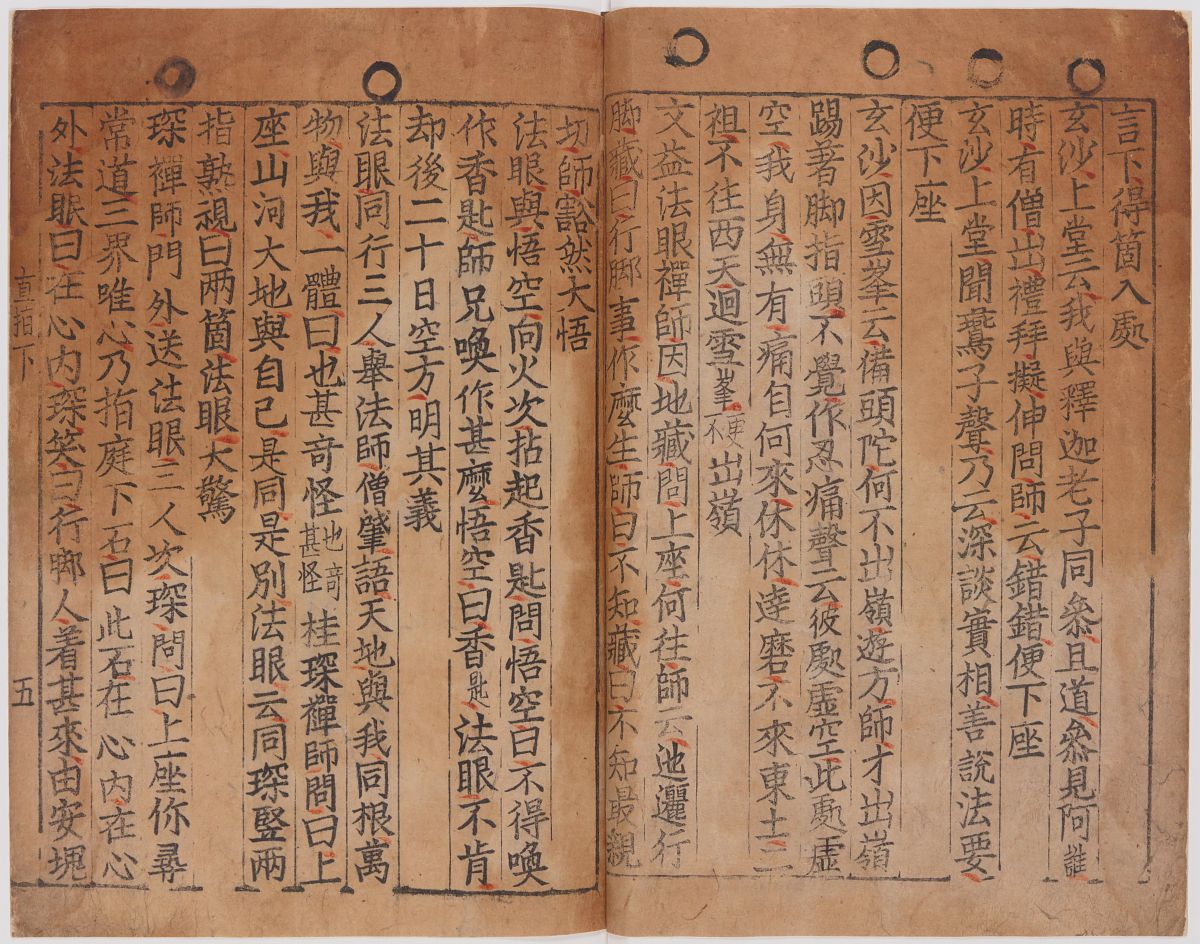
Jikji (Korean: 직지심체요절) is the abbreviated title of a Korean Buddhist document whose title translates as "Anthology of Great Buddhist Priests' Zen Teachings". Printed during the Goryeo Dynasty in 1377, it is the world's oldest extant book printed with movable metal type. UNESCO confirmed Jikji as the world's oldest book printed with movable metal type in September 2001 and inscribed it on the Memory of the World Register. Jikji was published in Heungdeok Temple in 1377 in 2 volumes, 78 years before Johannes Gutenberg's acclaimed "42-Line Bible" was printed between 1452 and 1455. Of the original metal printing, only the second volume survives and is kept at the Manuscrits Orientaux division of the National Library of France (BnF). The BnF hosts a digital copy online. Woodblock prints of Jikji were made later in 1378, and both volumes survive as a woodblock printing. 3 woodblock printings remain, in varying degrees of completeness. The title is derived from the phrase "Jikji Insim Gyeonseong Seongbul" (直指人心 見性成佛), meaning "When you see a person’s heart correctly through meditation, you realize that the nature of the heart is the mind of Buddha."
Read the fixed source
Follow the exact revision used for this summary, or open its history to see the contributors and later changes.
Text source & license
Adapted and shortened by SEOULIAN from the linked fixed revision; no change in factual meaning is intended. Source: Wikipedia contributors. This adapted summary is shared under CC BY-SA 4.0.
Image attribution
Title: Jikji pages
Author: Unknown author Unknown author
Source: Wikimedia Commons
License: Public domain
Wikimedia thumbnail downloaded and displayed without editorial alteration.