TWO OBJECTS, NOT ONE SILHOUETTE
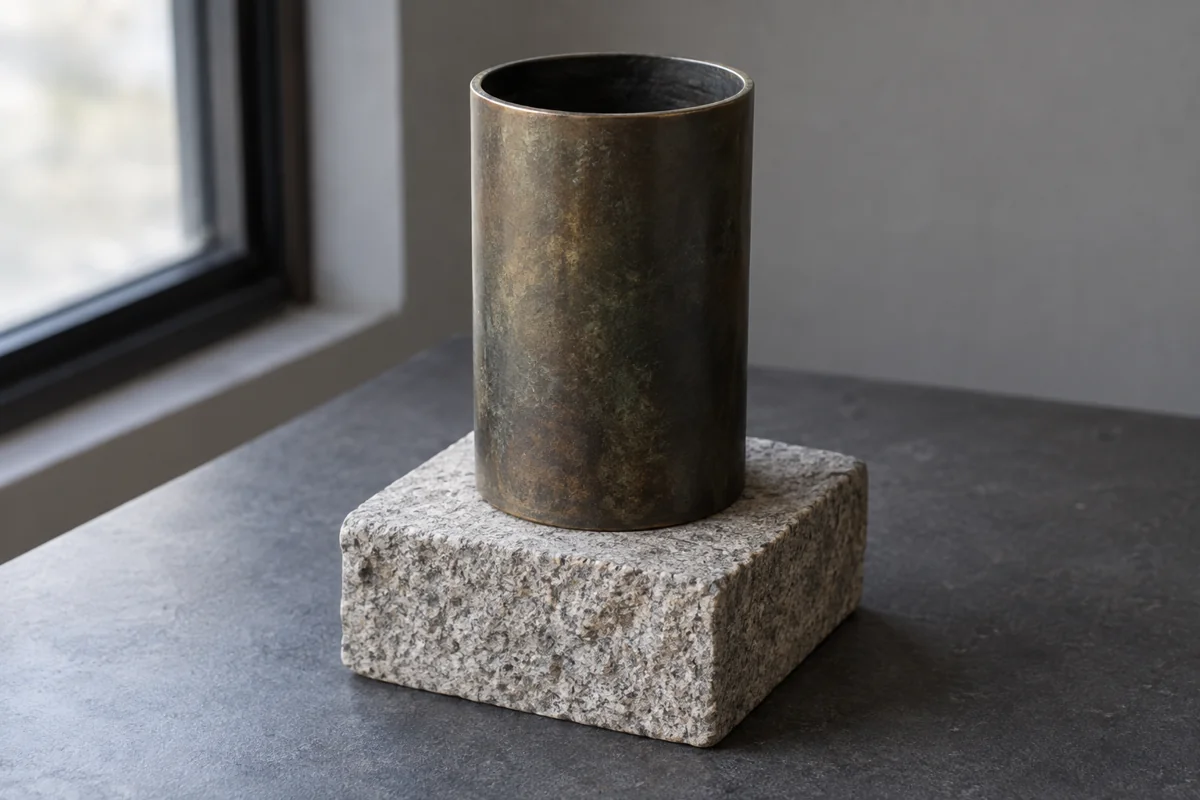
A rain gauge looks like a modest object for a museum: an open cylinder, sometimes sitting on stone. But the most useful first question is not how old the whole arrangement looks. It is which part the label is describing.
In Korean collection names, cheugugi (측우기) identifies the rainfall-measuring instrument; cheugudae (측우대) identifies its pedestal. The National Meteorological Museum of Korea's second gallery lists the Gongju rain gauge and the Daegu rain-gauge pedestal as separate objects. Read the last word carefully. The support is not simply anonymous furniture beneath the important exhibit.
FOLLOW THE WATER, THEN THE LABEL
The National Palace Museum of Korea's account explains the measuring idea through a vessel and a ruler: collect the rain, then measure its depth. The cylinder and the act of reading it belong to the same practical question—how much rain fell? A stone stand does another job, supporting the vessel.
SEOULIAN's looking suggestion is to separate function from age. First identify the opening that receives water and the base supporting it. Then look for the collection name, material and any note about reconstruction. You can understand the arrangement before you have mastered a dynasty's chronology.
Do not let a convincing overall shape make the decision for you. Two components shown together need not have the same history. A useful museum note can be as simple as two lines: what survives, and what has been added to help explain it.
A REPLICA CAN MAKE THE DISTINCTION CLEARER
The National Palace Museum's stone pedestal record, artifact Changdeok12942, explicitly distinguishes its accompanying barrel from the surviving support. It says the original barrel was lost and that the exhibited replacement was modeled on the Geumyeong rain gauge. The record is about a pedestal; the cylindrical part helps a viewer understand the assembly without becoming an original merely by standing on it.
Daejeon's National Science Museum offers another comparison. Its second-floor Korean History of Science and Technology Hall identifies the Tongyeong rain-gauge pedestal as an original exhibit. That is a reason to give the stone itself a full look, rather than treating the absence of a complete instrument as the absence of a story.
Our editorial takeaway is that original and replica answer different questions. One can carry material history; the other can clarify how parts relate. Read the museum's distinction, and keep it in your own description of what you saw. An online collection entry, however, does not promise that an object will be on view on your chosen day.
START IN SEOUL · Plan the visit separately
For a focused introduction, the National Meteorological Museum is at 52 Songwol-gil in Jongno-gu. Its current gallery page describes rainfall measurement and lists both the Gongju instrument and the Daegu pedestal. This gives you a specific question to take inside, rather than a requirement to learn every exhibit.
The operator and Korea Tourism Organization list opening hours of 10:00–18:00, with entry ending at 17:00. Regular closure is Monday, moving to the first following weekday when Monday is a public holiday; January 1 and the days of Seollal and Chuseok are also listed closures. The operator describes advance-reservation sessions for guided and self-guided visits, so consult its reservation and notice pages before setting out. Do not read the daily opening window as confirmation of an available session.
Sources were checked on September 18, 2026 (UTC). This guide does not settle competing accounts of the instrument's inventor or invention date. Its smaller invitation is immediately usable: when you encounter a cylinder on a block, find out whether you are looking at one historical object, two, or an original component with an explanatory replacement.
THE SEOULIAN SIGNAL · EDITORIAL INTERPRETATION
Why this matters
Read the label twice: once to identify the vessel or pedestal, and once to check whether each component is original or a replica.
SOURCE DESK · RESEARCH RECORDS
Research used for this analysis
- National Meteorological Museum of Korea Korea Tourism Organization · Cross-checks Seoul address, opening hours and closure rules against the museum operator. Checked September 18, 2026 UTC. Its invention-date, superlative and observatory-management wording is not adopted; no photos reused.
- Permanent exhibition, Gallery 2 National Meteorological Museum of Korea · Korea Meteorological Administration · Primary current exhibition record distinguishes the Gongju rain gauge and Daegu pedestal, and identifies the rainfall-measurement theme. Checked September 18, 2026 UTC. No claim about disputed Gwansanggam stand dating or invention priority.
- Rain Gauge Pedestal · Changdeok12942 National Palace Museum of Korea · Independently maintained collection record supports stone material, vessel-and-ruler measurement and the replacement barrel based on Geumyeong. Checked September 18, 2026 UTC. Inventor attribution, numerical dating and obsolete designation numbers are not reused; no collection image downloaded.
- 2F Korean History of Science and Technology Hall National Science Museum, Daejeon · Independent museum's exhibition record identifies the original Tongyeong rain-gauge pedestal in its second-floor hall. Checked September 18, 2026 UTC. Ambiguous 1811/1871 dating and world's-first claims are excluded.
- Visit information National Meteorological Museum of Korea · Korea Meteorological Administration · Operator's hours, closure rules and advance-reservation guided/self-guided sessions. Checked September 18, 2026 UTC. No booking availability, language guarantee, ticket price or firsthand access claim.
Original synthesis & image rights
Original SEOULIAN English synthesis of independently maintained public museum records and tourism information. Not a translation, copied label, firsthand exhibition review or claim about invention priority. No quotations, source photographs, plans or museum imagery are reproduced. The unique cover was made with built-in Imagegen and is an invented prop arrangement. AI-generated editorial illustration; not documentary evidence. Targets and reported usage remain attributed to the city and are not presented as independently verified outcomes.
Image disclosure
Credit: SEOULIAN · Created with ChatGPT Image Generation.
Creator: SEOULIAN with ChatGPT Image Generation
Source type: SEOULIAN imagegen editorial photo
Disclosure: AI-generated editorial illustration; not documentary evidence. An invented cylinder-and-stone prop arrangement, not a Korean museum artifact, actual exhibit or accurate historical reconstruction.
License: Original SEOULIAN AI-generated editorial image