Listen after the attack
A first encounter with gayageum can begin with a simple task: follow one note after it is plucked. The Korean Cultural Center New York’s instrument introduction describes strings supported by movable bridges. The setup helps explain why the sound need not remain fixed at the pitch of its first attack.
SEOULIAN’s listening suggestion is to notice the difference between the start of a note and what follows it. A sustained tone may bend or fluctuate as the player works the string. You do not need to name every gesture to hear that the instrument is being shaped continuously, rather than merely releasing a sequence of notes.
Not every gayageum looks the same
The cultural center describes the traditional twelve-string instrument alongside modern versions with more strings. The Academy of Korean Studies’ gayageum entry distinguishes the larger court-music form from the smaller instrument associated with sanjo. A single photograph is therefore not a universal specification.
When watching a performance, identify the particular instrument from the program or presenter if possible. Its proportions and string arrangement may reflect the music being played. Counting strings alone is less informative than asking what this version allows the musician to do and how it fits with the surrounding ensemble.
Give one phrase your attention
Try listening twice to a short phrase within an authorized recording or live performance. On the first pass, follow the melody. On the second, attend to the life of a single note: its beginning, its change and its fading. This is an editorial exercise, not an assertion that every gayageum performance uses the same effects.
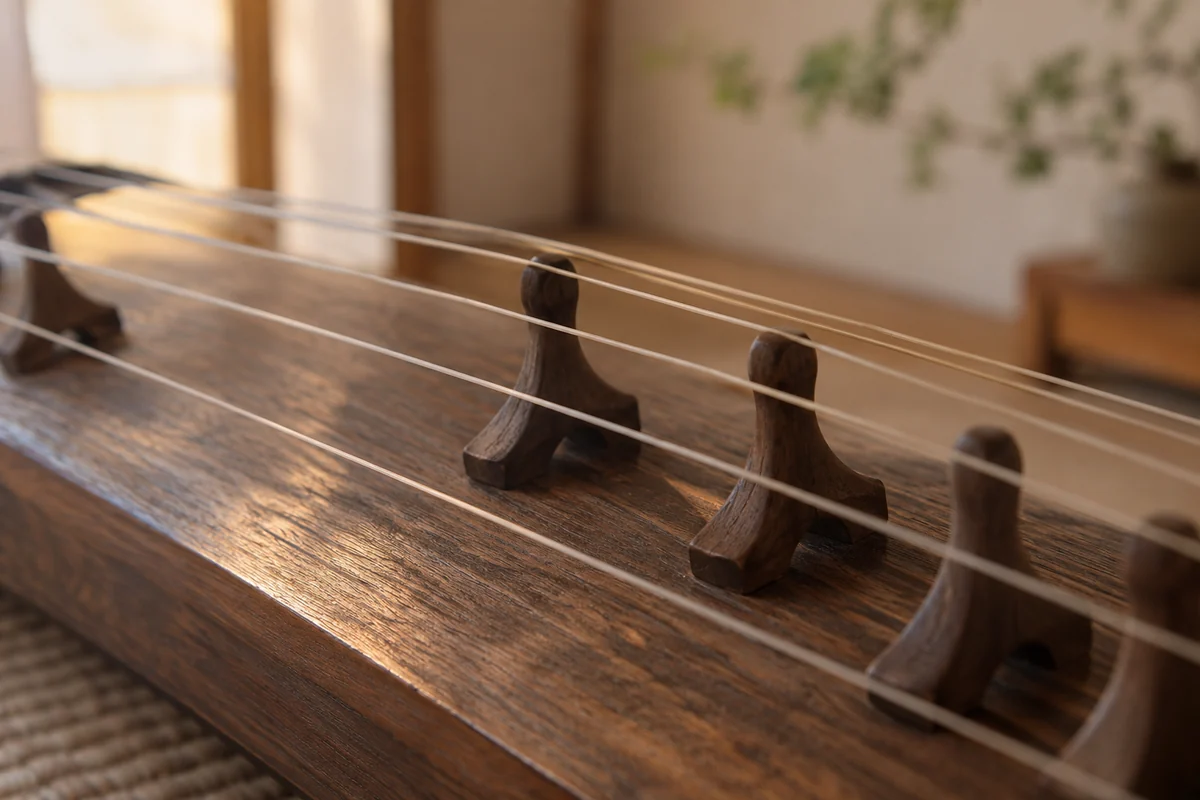
The cited cultural-center page documents a past program, not a current concert or a standing streaming entitlement. Use legitimate artist or institution channels for listening and respect their access conditions. The cover illustrates a generic structural detail; no performance image, album artwork or museum object photograph has been reproduced.
THE SEOULIAN SIGNAL · EDITORIAL INTERPRETATION
Why this matters
SEOULIAN editorial reading: A first listening guide to gayageum pitch bending and variants. This is a practical interpretive angle, not a popularity claim.
SOURCE DESK · RESEARCH RECORDS
Research used for this analysis
- Gugak Wednesdays: gayageum introduction Korean Cultural Center New York · Traditional strings, bridges and different instrument formats
- Gayageum — Encyclopedia of Korean Culture Academy of Korean Studies · Independent specialist account of court and sanjo forms, bridges and playing
Original synthesis & image rights
Original English synthesis by SEOULIAN from independently checked factual sources. No source prose, third-party photographs, artwork or recordings reproduced. Targets and reported usage remain attributed to the city and are not presented as independently verified outcomes.
Image disclosure
Credit: SEOULIAN · Created with ChatGPT Image Generation.
Creator: SEOULIAN with ChatGPT Image Generation
Source type: SEOULIAN imagegen editorial photo
Disclosure: AI-generated editorial illustration; not documentary evidence. A generic zither detail, not a historical specimen or an actual performance. SEOULIAN · Created with ChatGPT Image Generation.
License: Original SEOULIAN AI-generated editorial image