SEOULIAN INTERPRETATION · Start with the ingredient
A bright red drink on a Korean tea menu invites a reasonable question: what kind of tea is this? With omijacha (오미자차), the answer starts with fruit. Omija is the berry; cha identifies the drink. You are not simply choosing another color of green or black tea.
SEOULIAN's suggested first approach is practical: ask how this particular cup is made before deciding how sweet, warm or cold you want it. That small question is more useful than expecting the name to describe an identical drink in every cafe.
VERIFIED CONTEXT · What the five flavors mean
The Korea Tourism Organization explains omija as a fruit associated with five tastes: sweetness, sourness, bitterness, saltiness and a spicy or pungent quality. Its name refers to those five flavors. That is a description of the berry, not a promise that a prepared cup contains five equally strong sensations.
Treat the name as an invitation to pay attention, not a tasting exam. On your first sip, notice what reaches you first and what remains afterward. If your immediate impression is simply tart or sweet, there is no need to invent the other three.
KNOW THE FORM · Berries, infusion or cheong?
Mungyeong's municipal culinary-use guide distinguishes dried omija from a preparation that combines fresh berries with sugar. It describes infusing the dried fruit in water, straining it and adding a sweetener. The fruit-and-sugar preparation produces a liquid used for drinks including omija tea and ade.
That distinction matters at a shop. Dried fruit still requires preparation; a jar of omija-cheong (오미자청) is a sweetened concentrate, not automatically a ready-to-drink beverage. Read the actual label for dilution, storage and ingredients. Do not transfer a ratio from an unrelated bottle or assume that a deep color tells you the sugar content.
KTO describes a heated preparation using dried berries, while Mungyeong also describes an infusion method. This article does not prescribe a universal brewing temperature or provide a tested recipe. Follow the instructions for the product or preparation you actually choose.
A DIFFERENT KIND OF TEA · Warm is an option, too
In a Korean Food Promotion Institute interview, tea curator Lee Seul-gi discusses drinks made from ingredients other than tea leaves. Her omija example uses her mother's cheong and a tea bowl. The feature describes both a warm serving and the option of adding ice.
The useful lesson for a newcomer is that omija does not have to be understood only as a cold red refresher. At a cafe, ask what temperatures are offered and whether sweetness can be adjusted. If the drink starts with an already sweetened base, simply requesting no extra sugar may not make it unsweetened.
TRY IT · Three questions before the first cup
Ask: is this made from infused berries or a concentrate? What has been added? Is it served warm, iced or with sparkling water? These are suggested ordering questions, not claims about a particular shop's menu. If ingredients matter to you, ask about the whole drink rather than only its headline berry.
For a small tasting, choose one preparation and let it be itself. Notice aroma, the balance of tartness and sweetness, and the finish. Write down one thing you would change next time—perhaps temperature or dilution—instead of deciding immediately whether you like every possible version of omija.
The sources below were checked on September 18, 2026 (UTC). They support this culinary explanation; SEOULIAN is not endorsing the medicinal benefits mentioned on some source pages. No cafe opening hours, current stock, price or health outcome is promised here. The point is a more informed cup, not a cure.
THE SEOULIAN SIGNAL · EDITORIAL INTERPRETATION
Why this matters
Before ordering or buying, ask whether you are choosing a berry infusion, a sweetened concentrate to dilute, or a finished drink. The ingredient name alone does not answer that question.
SOURCE DESK · RESEARCH RECORDS
Research used for this analysis
- Omija Tea (오미자차 / Omijacha) Korea Tourism Organization · Official food reference: berry-based tea, meaning of the name, five tastes and a heated dried-fruit preparation. Published October 19, 2023; checked September 18, 2026 UTC. Medical and seasonal claims not used; no media reused.
- Interview with tea curator Lee Seul-gi — 이슬기 티 큐레이터 인터뷰 Korean Food Promotion Institute · Independently authored July 31, 2023 interview: non-leaf tea culture, the interviewee's use of omija-cheong and a tea bowl, and warm or iced serving options. Checked September 18, 2026 UTC. No direct quotation, recipe or health claim reproduced.
- Omija — regional specialty and culinary uses Mungyeong City · Mungyeong Geopark · Municipal source last marked updated July 6, 2025: separate fresh-fruit/sugar and dried-fruit preparations, straining, sweetening, and tea/ade uses. Original Korean page checked September 18, 2026 UTC. No medical benefits, production statistics, home-preservation schedule or dosage adopted.
Original synthesis & image rights
Original SEOULIAN English synthesis, not a translation, recipe reproduction or first-person tasting review. Sources are linked for ingredient and cultural verification; their text, photographs and medical claims are not reproduced. The cover was created with built-in ChatGPT Image Generation and shows a fictional serving. AI-generated editorial illustration; not documentary evidence. Targets and reported usage remain attributed to the city and are not presented as independently verified outcomes.
Image disclosure
Credit: SEOULIAN · Created with ChatGPT Image Generation.
Creator: SEOULIAN with ChatGPT Image Generation
Source type: SEOULIAN imagegen editorial photo
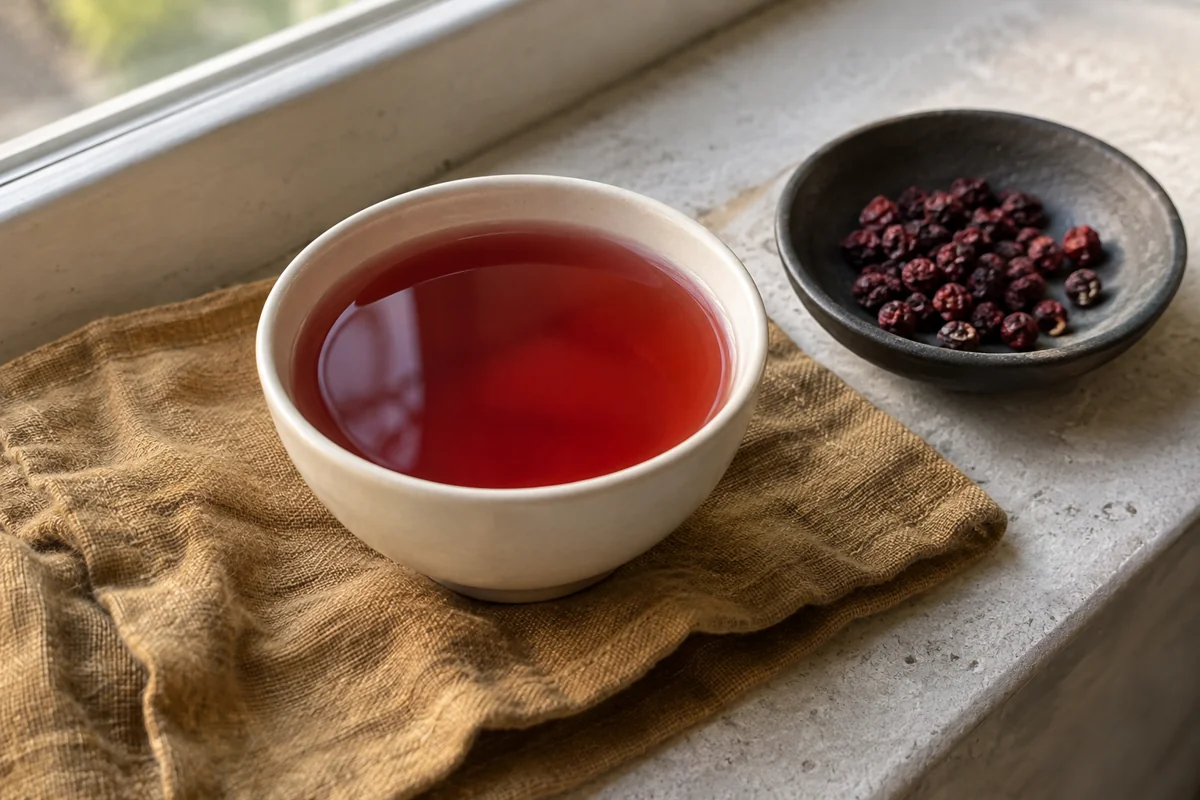
Disclosure: AI-generated editorial illustration; not documentary evidence. An imagined serving of omija tea and dried berries, not a real cafe, product, tested recipe or source photograph.
License: Original SEOULIAN AI-generated editorial image