The verified basics—and the important exception
Seoul Street Arts Festival 2026 runs on Saturday, September 19 and Sunday, September 20 at Ttukseom Hangang Park and Seoul Forest. The Seoul Metropolitan Government’s annual schedule, the current Seoul Culture Portal listing, and the Korea Tourism Organization’s VisitKorea page agree on the dates and the two venues. VisitKorea lists broad operating hours of 10 AM to 10 PM, varying by date, and says admission is free.
Free does not mean every work is an unlimited walk-up performance. Seoul Economic Daily reported an advance-reservation window from September 2 through 16 for selected programs. There is also a live-information wrinkle: VisitKorea gives a 10 AM–10 PM outer window, while the Seoul Culture Portal still marks detailed hours as forthcoming. Check each program page before building a route; if a reservation button appears, availability—not the festival’s general free-admission status—decides whether you can join that session.
Think of two cultural districts, not one fairground
This edition marks a geographical reset. The festival had been centered on downtown civic spaces such as Seoul Plaza, while the Seoul Foundation for Arts and Culture says the 2026 program relocates to Ttukseom Hangang Park and Seoul Forest. Its selection process explicitly considered whether works fit the scale and atmosphere of the river. That makes the landscape part of the curatorial idea, not merely a larger backdrop.
The two venues are separate urban spaces. Do not assume you can see a Seoul Forest performance and immediately appear at a Ttukseom riverside stage. Start from the official timetable, save the map location for every chosen work, and leave a transfer margin. If one performance is essential, anchor your day around it and treat nearby walk-up shows as the flexible layer.
Choose a route by how you want to move
The announced program spans compact circus, music, large-scale roaming work, and audience participation. VisitKorea’s broad operating window begins at 10 AM and extends into the evening, but no single route captures everything. A low-friction plan is to choose one park and two or three performances with comfortable gaps. Families and visitors who prefer less walking should prioritize a small cluster rather than chasing headline works across both areas.
For people who want movement to be part of the experience, the festival is expanding its ‘Artrekking’ concept. Seoul Economic Daily reports connections on foot and by bicycle, plus a Hangang Bus link between the Seoul Forest pier and Ttukseom. Treat that as a programmed route option, not as a universal backstage shuttle: recheck the official festival map and the transport timetable on the day, and never rely on a tight water-transfer connection for a reserved performance.
Language may be lighter; access questions are still specific
Street performance can be welcoming to international visitors because movement, music, circus, and visual scale often carry meaning without long dialogue. That does not make every work language-free. Some programs use recorded voices, headphones, instructions, or audience participation. Read the individual page for duration, participation age, reservation status, and the way language is used rather than judging from the festival category alone.
Outdoor viewing also rewards modest preparation: shoes suited to walking, water, a charged phone, and enough time to find an open-air stage. Keep bicycle lanes and performance paths clear, ask before taking a close portrait, and check the festival’s notice page on the morning of your visit. The organizer used that channel for weather and venue changes in previous editions, so it is the sensible source for late operational updates.
Why the river move is worth watching
A plaza concentrates attention; a river corridor distributes it. Moving street arts to Ttukseom and Seoul Forest asks the audience to become a navigator—walking, pausing, and noticing how performance changes an ordinary park route. That is SEOULIAN’s editorial reading of the format, not an official claim about results.
The most useful measure will not be the size of one crowd. It will be whether visitors can understand the two-park map, whether reserved and walk-up works coexist without confusion, and whether people with different ages, languages, and mobility needs can assemble a satisfying day from the published information.
THE SEOULIAN SIGNAL · EDITORIAL INTERPRETATION
Why this matters
The smartest festival itinerary may be the least ambitious one: reserve one must-see work, add two nearby walk-up performances, and leave room for the river path itself. In this edition, movement between stages is part of what Seoul is presenting.
SOURCE DESK · RESEARCH RECORDS
Research used for this analysis
- Major Tasks and Event Schedule for 2026 Seoul Metropolitan Government · Primary municipal source, published January 28, for the official September 19–20 festival dates.
- Seoul Street Arts Festival 2026 Seoul Culture Portal · Current municipal culture listing used to cross-check the dates, venues, free admission, general-audience access, and the fact that detailed hours remain subject to publication.
- Seoul Street Arts Festival Korea Tourism Organization — VisitKorea · Independent public tourism listing used to cross-check the dates, venues, broad operating hours, international program, admission, and contact details.
- Seoul Street Arts Festival 2026 — International Program Selection Result Seoul Foundation for Arts and Culture · Primary foundation notice confirming the move from downtown plazas and the program-selection emphasis on suitability for the Hangang setting.
- Giant Red Giraffes to March Along Han River at Seoul Street Arts Festival Seoul Economic Daily · Independent reporting used to cross-check the move, program scale, Artrekking connections, and the September 2–16 reservation window; the English page is AI-translated from original reporting, so claims were verified against current official sources and no wording or images were reproduced.
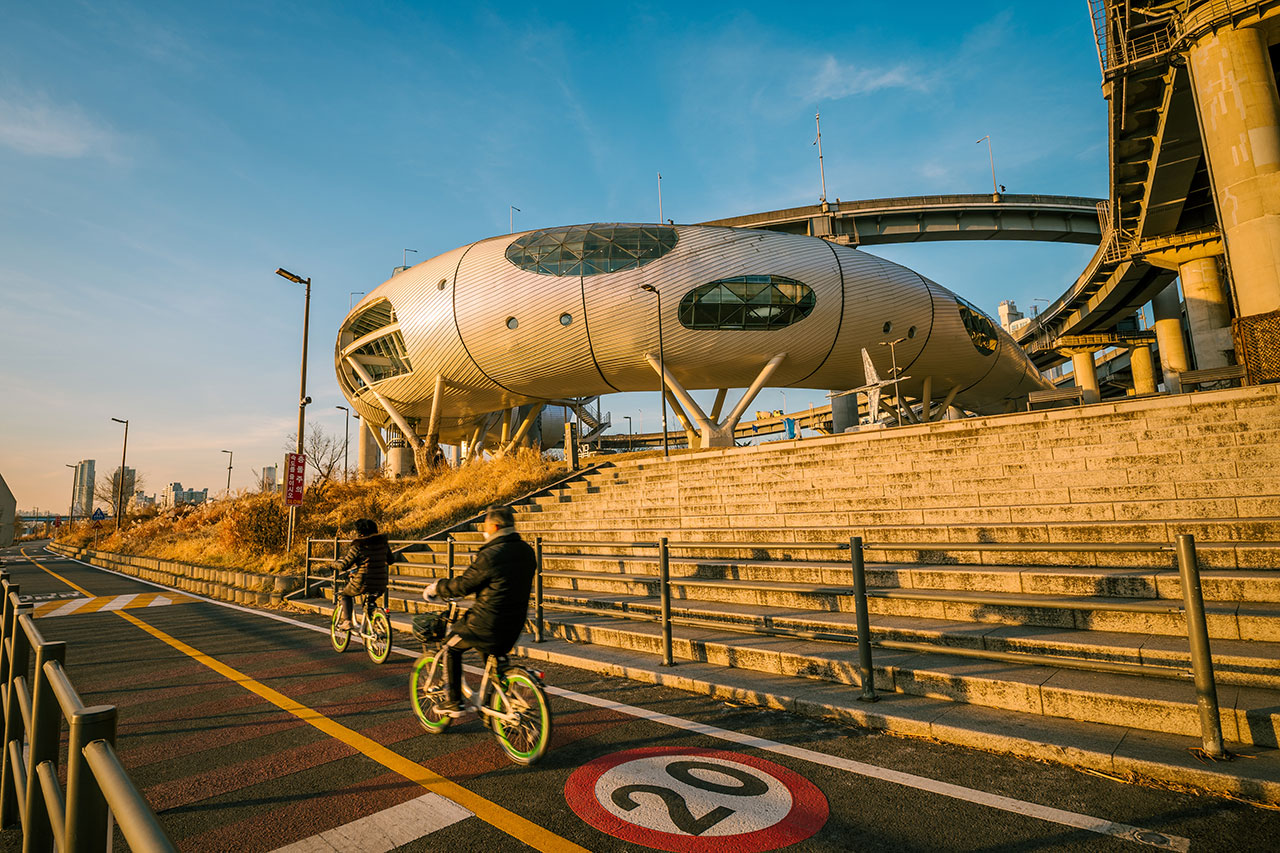
- Ttukseom Hangang Park J-Bug Seoul Metropolitan Government · Official source page for the licensed 2022 contextual cover photograph; it is not presented as a photograph of the 2026 festival.
Original synthesis & image rights
SEOULIAN independently synthesized and checked facts from Seoul Metropolitan Government, Seoul Culture Portal, the Korea Tourism Organization, the Seoul Foundation for Arts and Culture, and Seoul Economic Daily without reproducing their wording. The official 2022 venue photograph is stored locally unaltered, credited under the city’s KOGL Type 1 policy, and is contextual—not documentary evidence of the 2026 festival. Targets and reported usage remain attributed to the city and are not presented as independently verified outcomes.