Start with a flavor question
Imagine finishing dinner and being offered a drink whose name you cannot quite place. Rather than asking which one is more authentically Korean, try a smaller question: would you like a grain-based sweetness, or cinnamon and ginger? Sikhye and sujeonggwa offer two different answers. Learning their names turns an unfamiliar final course into something you can choose deliberately.
The Korea Tourism Organization identifies sikhye as sweet rice punch and sujeonggwa as cinnamon punch in its guide to holiday foods. Both appear alongside traditional sweets. That is a useful introduction, not a rule that either drink belongs only to holidays or must arrive at the end of every Korean meal.
Sikhye: rice is part of the drink
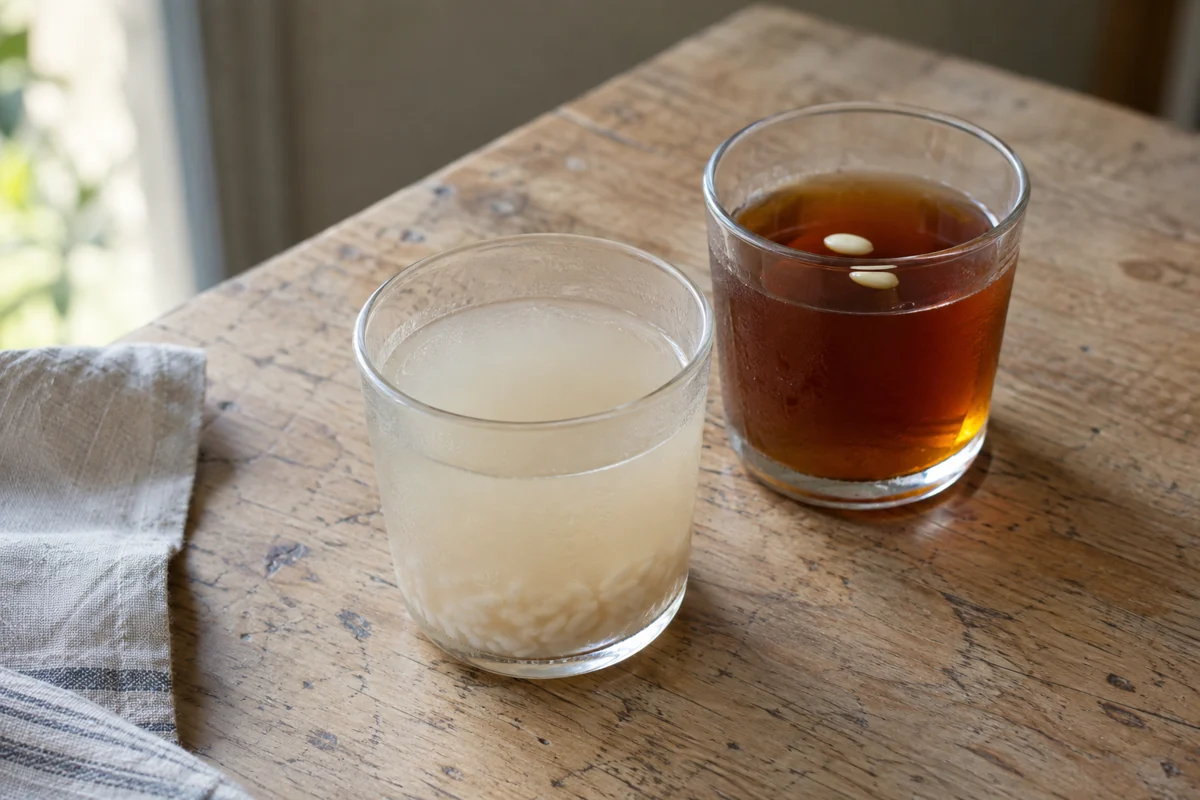
Food writer Hyosun's Korean Bapsang explains sikhye as a non-alcoholic drink made with cooked rice and barley malt. Rice grains may remain in the serving. The name rice punch can therefore be misleading if it makes you expect a smooth rice milk: the malt is part of its character, not an incidental extra.
For a first tasting, our suggestion is to notice the liquid before the texture. Take a small sip, then try a little of the rice if your serving contains it. Ask for a spoon if that makes the experience easier. You are learning what you like, not demonstrating table manners to an imaginary examiner. Versions differ, so one cup need not settle your opinion of the whole category.
Sujeonggwa: a cool drink with spice
The tourism organization's separate sujeonggwa entry describes a chilled, sweetened cinnamon-and-ginger drink, with possible garnishes including dried persimmon, jujube or pine nuts. Cinnamon punch is a helpful English cue, but ginger matters too. Do not mistake a warming flavor for a promise that the drink will be served hot.
Our suggested comparison is about contrast, not ranking: notice the rice-and-malt character of sikhye beside the spice-led character of sujeonggwa. If you are trying both with a friend, use separate cups and leave room for different preferences. One person may enjoy the spice; another may prefer the grain flavor. Neither response requires a cultural explanation.
Three useful questions before ordering
Ask what is in this particular version, whether it is served chilled and whether the cup is included with the meal or ordered separately. A familiar drink name does not establish a restaurant's ingredients, portion size or price. Check the menu or packaging rather than assuming that a complimentary serving elsewhere makes this one free.
If ingredients matter to your diet, ask about both the drink and its garnish. The rice in the name does not tell the whole ingredient story, and the decoration is still food. This is not an allergy-safety guide; we cannot verify an individual kitchen's preparation. Nor do we repeat claims that either drink improves digestion or offers a health benefit.
A quieter souvenir than another checklist
Here is our invitation for your next Korean meal: learn one drink name well enough to recognize it on a menu. You do not need to buy both, photograph the table or turn the experience into a tasting competition. Remembering that you prefer cinnamon to malt can be a more useful souvenir than remembering which item a list told you to order.
Fact check: September 12, 2026. This article draws on the Korea Tourism Organization's food descriptions and Korean Bapsang's independent explanation of sikhye. It is an original tasting-oriented synthesis, not a recipe, a nationwide preference survey or a current restaurant-price guide. The sources' recipes, photographs and health assertions are not reproduced.
THE SEOULIAN SIGNAL · EDITORIAL INTERPRETATION
Why this matters
SEOULIAN interpretation: flavor cues and a few ordering questions can make traditional drinks approachable without turning a meal into a test of cultural knowledge.
SOURCE DESK · RESEARCH RECORDS
Research used for this analysis
- Cinnamon Punch (Sujeonggwa), October 19, 2023 Korea Tourism Organization · Primary tourism food entry: chilled cinnamon-ginger drink and possible garnishes. Facts only; no image or expression reuse.
- 6 Signature Foods Made for Traditional Korean Holidays, updated September 2025 Korea Tourism Organization · Context for both drinks alongside Korean sweets; same organization as the first source, not counted as independent.
- Sikhye (Rice Punch), updated April 2, 2025 Korean Bapsang · Hyosun · Independent food writer: rice, barley malt, non-alcoholic format and rice grains. Recipe steps, storage advice, health claims and photographs not reused.
Original synthesis & image rights
Original SEOULIAN synthesis of linked factual sources. Interpretation and practical suggestions are editorial judgments. Organizer-associated reporting is attributed, not an independent audit. No source prose, lyrics, celebrity or event photographs reproduced. Unique built-in Imagegen cover is disclosed and is not documentary evidence. Targets and reported usage remain attributed to the city and are not presented as independently verified outcomes.
Image disclosure
Credit: AI-generated editorial illustration; not documentary evidence. An imagined setting, not a photograph of an actual business, event or performer.
Creator: SEOULIAN with ChatGPT Image Generation
Source type: SEOULIAN imagegen editorial photo
Disclosure: AI-generated editorial illustration; not documentary evidence. An imagined setting, not a photograph of an actual business, event or performer.
License: Original SEOULIAN AI-generated editorial image