A meal need not have a permanent room
Imagine bringing the eating surface along with the dishes. That is a useful way into soban (소반), Korea's small portable dining tables: an object with something of a serving tray and something of a table. In a 2015 interview with a soban maker, The Korea Times described their use across different rooms of the home. The interesting design question is not only what the table looks like, but what becomes possible when it can move.
SEOULIAN's reading is simple: a dining place can be an arrangement, not a room permanently assigned to one task. This is not a claim that every Korean household lived—or lives—the same way. It is an invitation to notice an everyday object that makes furniture, food and space easier to think about together.
Start with the legs, then look at the edge
The National Museum of Korea's online record for a wooden Joseon-period table identifies it as gaedari soban, also called gujokban: a name referring to dog-like legs. The catalog gives its height as 24.7 centimeters and diameter as 32 centimeters. Those measurements belong to this particular object, not to every soban. Even on a screen, they help replace the vague idea of 'small furniture' with a scale you can picture.
Try a short looking exercise with the linked record. Follow one leg upward to the tabletop. Then trace the outline of the top and examine the decoration separately. Keep description ahead of interpretation: what is curved, what is flat, and what is ornament? You do not need a vocabulary of woodworking terms to begin. Treat a photograph as a starting point, not enough evidence to identify the wood, age or maker of an unfamiliar table.
Similar tables can have different jobs
A contrasting record at the Seoul Museum of Craft Art describes a hojokban with a twelve-sided top and tiger-shaped legs. The museum identifies this example as a siru table used to hold rice cakes at weddings. It records dimensions of 59.3 by 57.7 centimeters and a height of 38 centimeters—substantially different from the National Museum example.
The point is not to turn two artifacts into a complete classification system. It is to resist treating all low wooden tables as interchangeable. Shape can catch your eye first; the documented use can change what you see next. A label about an occasion, material or construction detail is often the most rewarding part of the encounter.
Build a small comparison, not a shopping checklist
Ewha Womans University Museum's archive offers another useful approach. Its 1982 soban exhibition grouped objects by material, shape, use and region. That is a past exhibition, not a current event recommendation. Its framework remains a practical way to compare the museum records linked below without deciding that one table must be the most representative or the most beautiful.
Choose just two examples. Write down one visible difference, then one difference stated in their descriptions. Finally, note one question the records do not answer. This little exercise works from home as well as before a museum visit. An online collection entry is not a promise that the object will be in a gallery on your chosen day; confirm the current display with the institution if seeing a specific piece is the purpose of your trip.
Take the idea home without buying an antique
Our practical suggestion is to experiment with a movable setting you already own: a stable tray on a suitable surface, one cup, and room to set it down comfortably. Notice how a small arrangement can give an ordinary break a beginning and an end. This is an exercise inspired by portability, not a claim that a household tray is a traditional soban.
If you do shop for one, ask about intended use, dimensions, weight, finish and care rather than relying on a photograph or the word 'traditional.' Separate a maker's documented description from a seller's decorative language. The pleasure of discovering soban need not end in a purchase. It can begin with a better question: what do you want this corner of the room to become for the next few minutes?
THE SEOULIAN SIGNAL · EDITORIAL INTERPRETATION
Why this matters
Try reading the table from the floor upward: the legs, edge and available surface can tell you more than the umbrella label 'traditional Korean furniture.' Check an individual object's record before assuming its purpose or where it is displayed.
SOURCE DESK · RESEARCH RECORDS
Research used for this analysis
- Hojokban · collection CR-AP-00-000108 Seoul Museum of Craft Art · Primary object record for the twelve-sided top, leg form, wedding rice-cake use and dimensions; collection photography is not reused.
- Dining Table · Namsan2322 National Museum of Korea · Primary collection record for the gaedari soban/gujokban name, period, material and object-specific dimensions; no current display guarantee is inferred.
- So-ban (Table) in Joseon Dynasty · past exhibition, 1982 Ewha Womans University Museum · Independently curated historical exhibition record and comparison framework: material, shape, use and region. Clearly identified as an archive, not a current exhibition.
- Soban: more than small tables · May 10, 2015 The Korea Times · Chung Ah-young · Independent reported interview with maker Park Jong-deok, used for historical background on the combined tray/table function and use across rooms; not a present-day business or availability claim.
Original synthesis & image rights
Original SEOULIAN synthesis based on the linked museum records and independently reported background. No source prose, collection photographs or maker-specific designs are reproduced. The cover is an original AI-generated editorial illustration, not documentary evidence or an authenticated historical reconstruction. Targets and reported usage remain attributed to the city and are not presented as independently verified outcomes.
Image disclosure
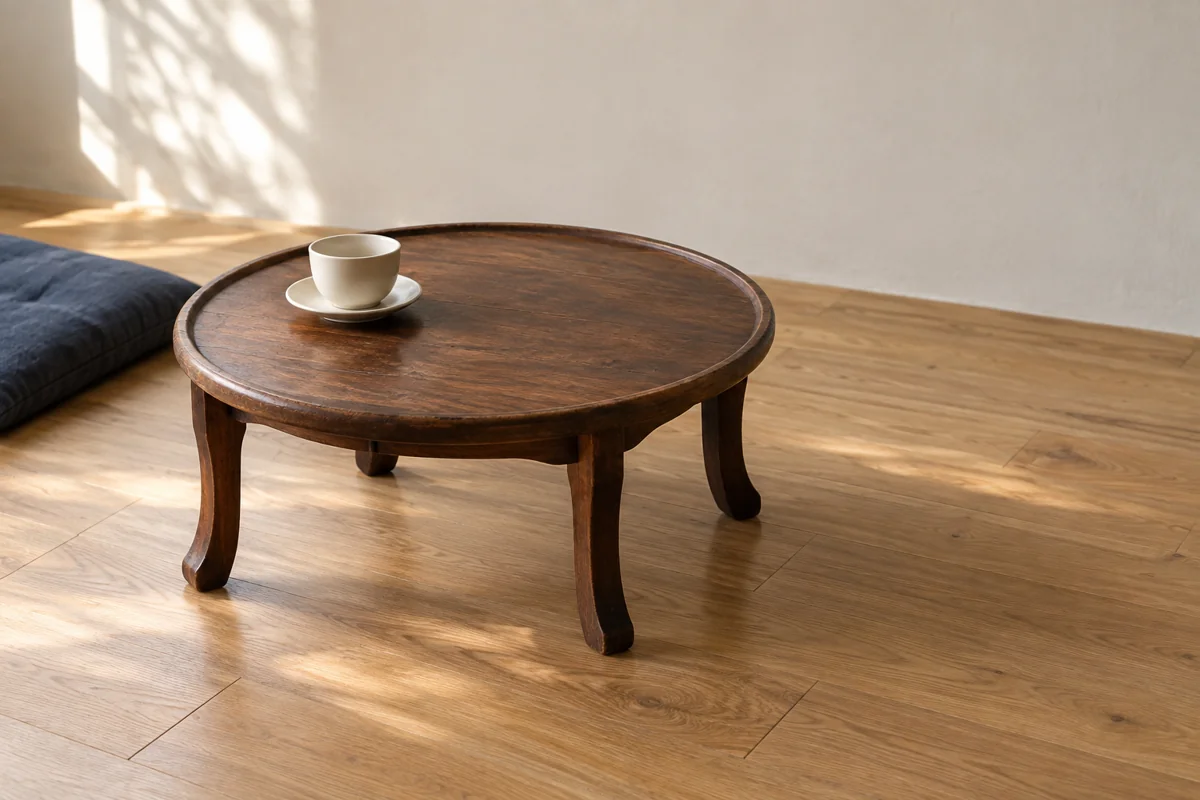
Credit: AI-generated editorial illustration; not documentary evidence. An invented everyday table, not a photograph of a museum object or an authenticated historical reconstruction. SEOULIAN · Created with ChatGPT Image Generation.
Creator: SEOULIAN with ChatGPT Image Generation
Source type: SEOULIAN imagegen editorial photo
Disclosure: AI-generated editorial illustration; not documentary evidence. An invented everyday table, not a photograph of a museum object or an authenticated historical reconstruction. SEOULIAN · Created with ChatGPT Image Generation.
License: Original SEOULIAN AI-generated editorial image