VERIFIED CONTEXT · A small cake with two stories
Start with the question the display cannot answer: what is inside? Songpyeon are filled Korean rice cakes associated with Chuseok, the autumn harvest holiday. The Korea Tourism Organization's September 2026 guide describes the familiar half-moon shape, fillings including sesame and beans, and steaming with pine needles. That is a useful introduction, but not a complete description of every piece on a shop tray.
For a first purchase, separate the outside from the center. The dough contributes its own ingredients, appearance and texture; the filling is another choice. Our suggestion is to learn that distinction before trying to memorize a rainbow of rice cakes. You can leave with a small selection and a much clearer idea of what you chose.
READ THE OUTSIDE · Color belongs to the dough
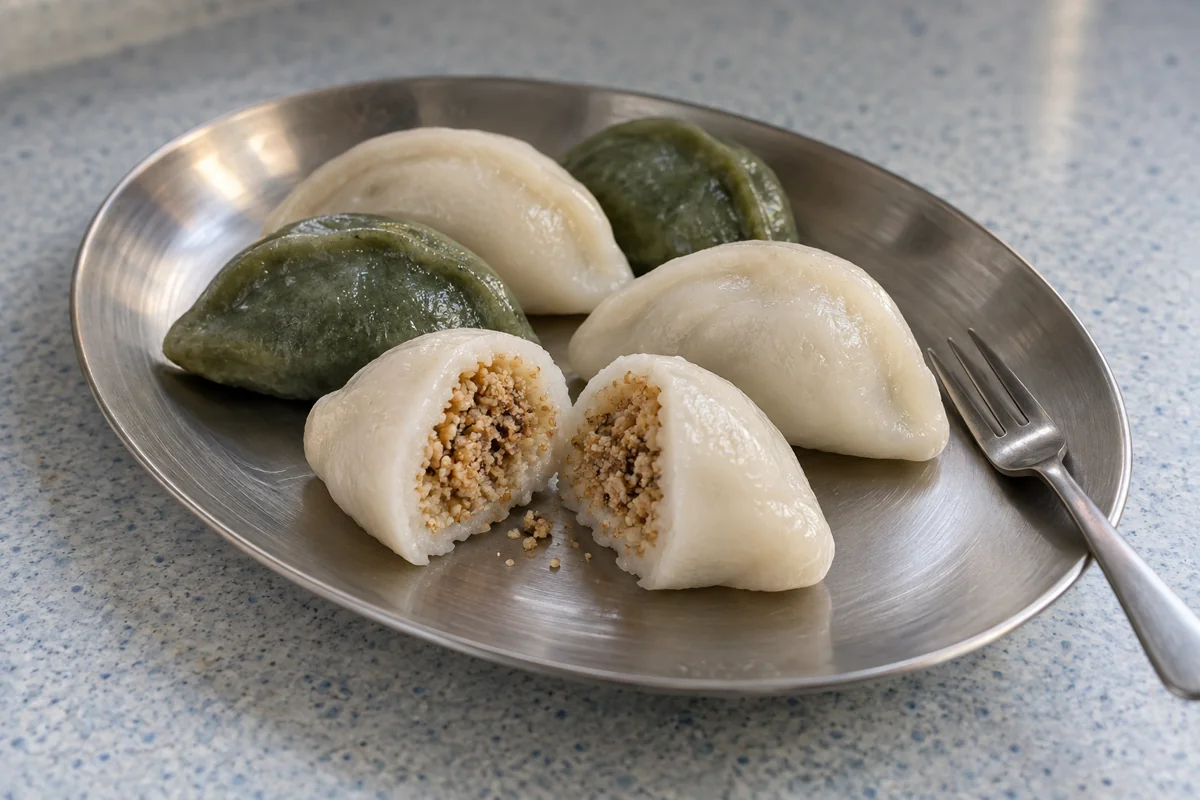
KTO's entry for five-color songpyeon describes ingredients such as gardenia and mugwort being incorporated into the dough, while listing chestnut, young soybean and sweetened sesame among possible fillings. Hyosun's independently authored recipe at Korean Bapsang offers another example: mugwort for green dough and kabocha squash for yellow. The two sources show why a color can begin a conversation without settling the ingredient question.
The practical lesson is not to turn those examples into a universal shop code. A green exterior can prompt a question about mugwort; it cannot, by itself, tell you what is sealed inside. Ask the seller about both layers. If ingredient requirements matter to you, use the maker's full information rather than a visual guess or this general guide.
READ THE CENTER · Choose a comparison, not a ranking
Sesame and beans are not interchangeable descriptions of a filling. Korean Bapsang discusses sweetened sesame, black soybeans and mung beans as variations. KTO's five-color entry supplies another example: ground sesame mixed with sugar. These are documented choices, not a promise that every shop makes all of them or sweetens them in the same way.
SEOULIAN's tasting suggestion is modest: if the seller offers a choice, pick two clearly identified fillings. Notice the center separately from the surrounding rice dough. Keep the names with the pieces until you have tried them, especially when bringing a mixed box to share. The point is to find a preference, not to declare one version the most authentic.
BEFORE BUYING OR MAKING · Three useful checks
KTO's current holiday guide points readers toward traditional markets and rice-cake shops for seasonal foods. It does not guarantee an individual seller's stock. Before making a special trip, confirm availability; at the counter, ask what the filling is and how that particular product should be kept and served. Follow the seller's instructions rather than assuming a single storage rule covers fresh and packaged products.
Making your own is a different decision. Korean Bapsang distinguishes moist rice powder from dry flour and discusses adaptations separately. That is a reason to read a chosen recipe's flour notes before shopping, not to assume that every bag labeled rice flour behaves identically. Follow the original author's full instructions if you decide to cook; SEOULIAN has not kitchen-tested a recipe for this article.
SEOULIAN INTERPRETATION · Let the question travel with the box
A beautiful assortment becomes more interesting when somebody can explain what differs between the pieces. Sharing that information gives a newcomer a way to join the conversation without pretending to know the whole tradition. Begin with the color if it catches your eye, then ask about the filling. The second question is where your own discovery starts.
THE SEOULIAN SIGNAL · EDITORIAL INTERPRETATION
Why this matters
Choose by two separate questions: what gives the dough its color, and what fills the center? The answer is more useful than choosing a color alone.
SOURCE DESK · RESEARCH RECORDS
Research used for this analysis
- 2026 Chuseok Holiday Travel Guide · September 14, 2026 Korea Tourism Organization · Current official primary tourism context for the holiday food, half-moon shape, fillings, pine-needle steaming and general market/rice-cake-shop availability. No event schedule, individual shop stock or source image reused.
- Songpyeon (Half-moon Shaped Rice Cake) · published September 9, 2019; updated September 14, 2021 Hyosun · Korean Bapsang · Independent recipe author's primary account of mugwort and kabocha dough colors, sesame and bean fillings, and distinct wet/dry rice-flour notes. Linked for readers wishing to cook; no recipe sequence, quantities, photos or video copied.
- Five-Color Half-Moon Rice Cake · October 19, 2023 Korea Tourism Organization · Additional official food reference distinguishing dough-color ingredients from chestnut, soybean and sweetened sesame fillings. Same institution as the first source, not a third independent organization.
Original synthesis & image rights
Original English synthesis by SEOULIAN from linked factual sources. No source sentences, recipe instructions, quantities, photographs or videos are reproduced. Two cited pages belong to the Korea Tourism Organization and are not counted as independent of each other. The cover is a unique AI-generated editorial illustration, not documentary evidence, a tested recipe or an actual seller's product. Targets and reported usage remain attributed to the city and are not presented as independently verified outcomes.
Image disclosure
Credit: AI-generated editorial illustration; not documentary evidence. An imagined serving of songpyeon, not a tested recipe or a photographed shop product. SEOULIAN · Created with ChatGPT Image Generation.
Creator: SEOULIAN with ChatGPT Image Generation
Source type: SEOULIAN imagegen editorial photo
Disclosure: AI-generated editorial illustration; not documentary evidence. An imagined serving of songpyeon, not a tested recipe or a photographed shop product. SEOULIAN · Created with ChatGPT Image Generation.
License: Original SEOULIAN AI-generated editorial image