Begin with texture, not a translation
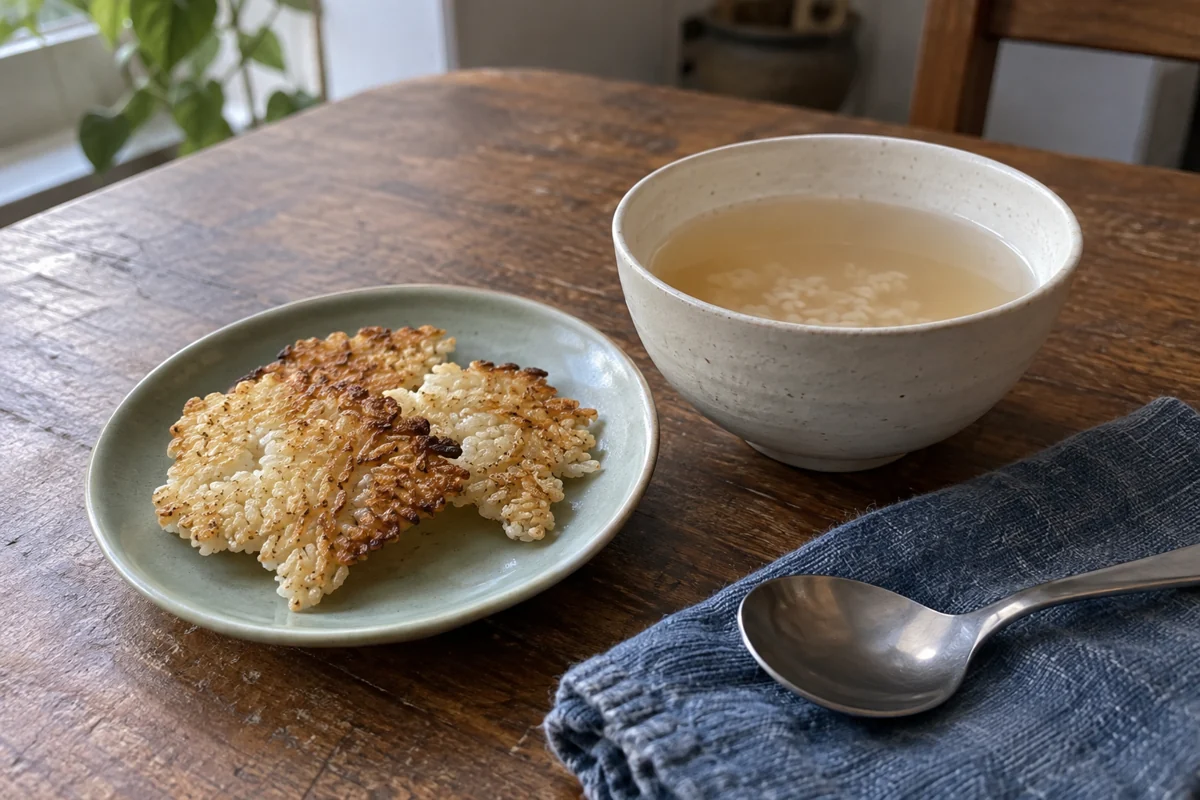
Imagine being offered a piece of toasted rice and then a pale bowl of warm liquid. They might look like separate foods, yet the connection is simple: rice that has formed a crust against the cooking pot can be eaten crisp or used to flavor water. Learning that relationship makes two unfamiliar menu words easier to remember.
Nurungji is the toasted rice crust. Sungnyung is the rice infusion made with water and that toasted rice. Korea Tourism Organization describes both uses in its food entry; a 2024 Food Science and Preservation paper independently distinguishes the snack, infusion and soup forms in its introduction. The National Institute of Korean Language confirms the romanization sungnyung for 숭늉. These are names to help you ask a question, not a pronunciation exam.
One ingredient, a different kind of attention
KTO describes the crust as golden, firm and aromatic, and notes that it is also produced separately as a snack. That matters when browsing a shop: nurungji need not be something scraped from the pot in front of you. The word describes a food, not proof of a particular cooking performance.
SEOULIAN interpretation: the appeal of meeting both forms is the change in what you notice. With the dry version, pay attention to the first bite and the grain texture. With the warm infusion, take your time with the aroma and the liquid. You are not looking for a correct preference; the comparison is the activity.
If you are sharing the experience, ask your companion which version they would choose again. A useful food conversation can begin with texture rather than a rating. Someone who prefers the drink has not failed to appreciate the snack, and neither choice needs to stand for what all Koreans enjoy.
Three useful questions before ordering
First, ask which form is being served: a dry snack, a bowl with softened rice, or the toasted-rice drink. An English menu's short label may not answer that practical question. Show the Korean words 누룽지 or 숭늉 if that makes the conversation easier.
Second, ask whether it comes with the meal or is a separate order. This guide does not establish any restaurant's price, refill policy or service sequence. Do not assume that an unfamiliar bowl is complimentary simply because it arrives near the end of lunch.
Third, if choosing a packaged version, read its preparation directions and ingredient list. The basic food description is not a guarantee that every commercial product has identical ingredients or is intended to be eaten dry. For home cooking, follow a complete recipe and instructions suitable for your cookware rather than improvising from this short cultural guide.
A small distinction worth keeping
Our suggestion is modest: remember the crust and the infusion as related but different experiences. There is no need to turn this into a claim about national character, ancient origins or a universal restaurant custom. An ordinary ingredient can be interesting enough on its own.
Fact-checked September 13, 2026 against KTO's September 11, 2025 food entry, Iradukunda and Kang's 2024 research paper, and the language institute's spelling record. The paper is used only for its background distinction between food forms, not to generalize its experimental formulation into a home recipe or a health claim. Its text, figures and tables are not reproduced. No nutritional benefit, medical effect or restaurant availability is claimed. The cover is a fictional AI food illustration, not a photograph of a tested recipe or a named business.
THE SEOULIAN SIGNAL · EDITORIAL INTERPRETATION
Why this matters
SEOULIAN interpretation: texture can be a more inviting first question than whether a food is authentic.
SOURCE DESK · RESEARCH RECORDS
Research used for this analysis
- Scorched Rice (Nurungji), September 11, 2025 Korea Tourism Organization · Primary tourism food reference: crust, sensory description, snack and infusion forms.
- Physicochemical quality characteristics of nurungji prepared from rice and Raphanus sativus powder (2024) Food Science and Preservation / Iradukunda and Kang · Independent academic background corroborates snack, infusion and soup distinctions. No experimental or health claims adopted; no CC BY-NC text, figures or tables reused.
- Romanization example: 숭늉 National Institute of Korean Language · Official spelling evidence only; not independent evidence for taste, custom or health effects.
Original synthesis & image rights
Original SEOULIAN synthesis of linked factual sources. Practical suggestions and interpretation are editorial judgments, not reported universal customs. No source prose, lyrics or photographs reproduced. Unique built-in Imagegen cover is disclosed and is not documentary evidence. Targets and reported usage remain attributed to the city and are not presented as independently verified outcomes.
Image disclosure
Credit: AI-generated editorial illustration; not documentary evidence. A fictional food still life, not a tested recipe or a photographed business.
Creator: SEOULIAN with ChatGPT Image Generation
Source type: SEOULIAN imagegen editorial photo
Disclosure: AI-generated editorial illustration; not documentary evidence. A fictional food still life, not a tested recipe or a photographed business.
License: Original SEOULIAN AI-generated editorial image