SEOULIAN INTERPRETATION · Start with the hands
You do not need to recognize a melody to find a way into an unfamiliar instrument. With the haegeum (해금), try a smaller question: what is each hand doing? One works beside a slender upright neck; the other moves a bow. Separating those two jobs gives a first-time listener something concrete to follow.
This is an invitation to notice, not a test of musical knowledge. Instead of deciding immediately whether the sound is sad, bright or strange, watch how it begins and how it changes. Leave the emotional description until after the listening.
VERIFIED CONTEXT · A small body and two strings
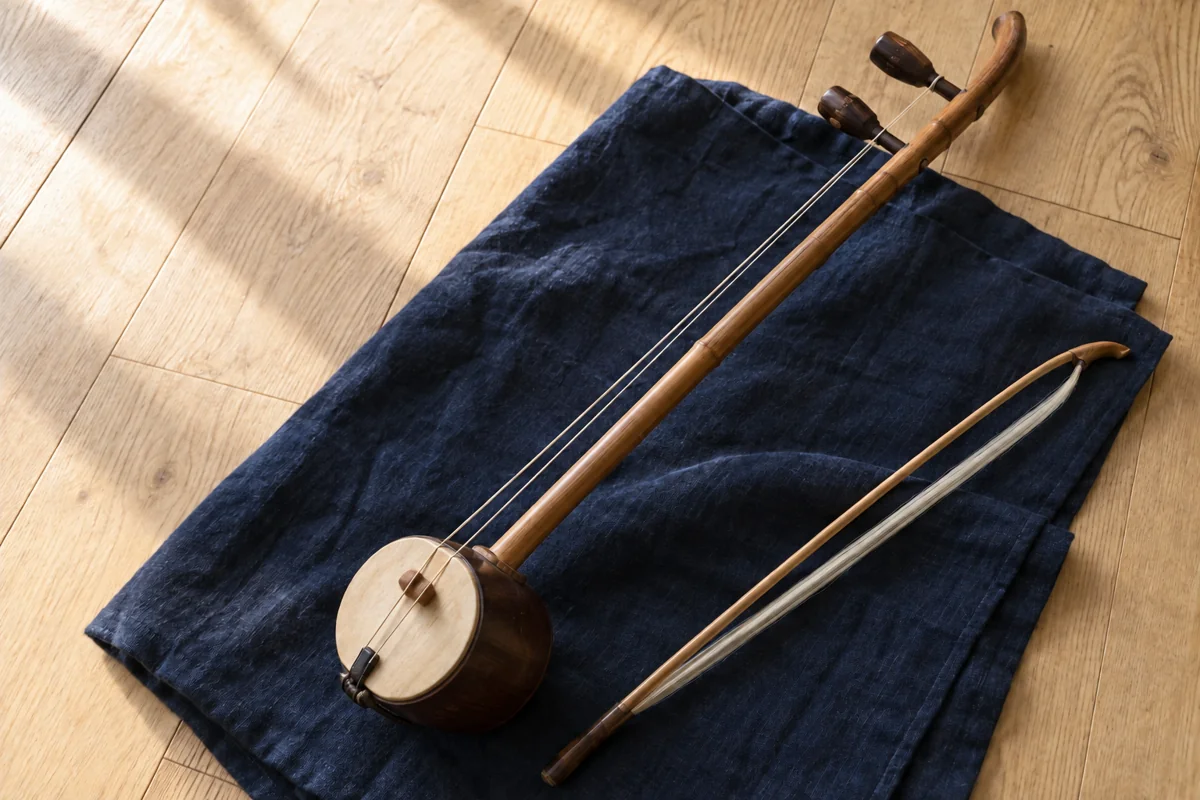
The National Gugak Center describes a hollow wooden sound box, a narrow neck and two silk strings. In performance, the instrument stands upright on the player's knee. The center assigns different roles to the hands: the left changes string tension, while the right handles the bow.
An independent collection record at New York's Metropolitan Museum of Art corroborates the two-string, upright playing arrangement. Its approximately 1980 example has a wooden bridge and a bamboo bow with horsehair. That is a description of one documented object, not a promise that every maker uses identical details. The museum currently lists this example as not on view; use its online record for study, not as a reason to book a gallery visit.
VERIFIED CONTEXT · Why the missing fingerboard matters
A June 2025 Ministry of Culture, Sports and Tourism feature highlights a useful distinction: the haegeum has no fingerboard. It explains pitch control in terms of finger placement and string tension. A violin comparison may help you recognize a bowed instrument, but it does not explain the whole physical action.
SEOULIAN's suggestion is to watch a short passage twice. First follow the bow's direction and the length of its movement. Then return your attention to the other hand and listen for changes within a sustained sound. This is a beginner's observation exercise, not a technical analysis of a named performance or instructions for learning to play.
TRY IT · Follow the official listening trail
The National Gugak Center's instrument entry on Google Arts & Culture includes an external link labeled Haegeum sanjo. Start from that credited entry rather than a repost stripped of its source. The same entry places the instrument in both solo and ensemble settings, so one clip should be a beginning rather than a verdict on its entire range.
For a second listen, choose a recording that identifies its performer and program. Ask whether you are following one instrumental line or noticing how it sits among others. You can enjoy the contrast without turning it into a ranking of which version is more authentic. No recording or performance image has been copied into this article.
PRACTICAL NOTE · A Seoul visit needs a program check
If you want to continue in person, Korea Tourism Organization lists the National Gugak Center at 2364 Nambusunhwan-ro, Seocho-gu, Seoul. Its visitor listing says hours and admission charges vary by performance. Check the center's current program, instrumentation, ticket price and date before traveling; a general gugak listing does not guarantee that haegeum appears in every concert.
Sources and the museum display status were checked on September 18, 2026 (UTC). This guide makes no claim of having attended a concert. Its purpose is simpler: the next time a slim upright fiddle catches your eye, you will have a question to listen with.
THE SEOULIAN SIGNAL · EDITORIAL INTERPRETATION
Why this matters
Follow one hand at a time: noticing the separate jobs of string tension and bow movement makes an unfamiliar instrument easier to approach.
SOURCE DESK · RESEARCH RECORDS
Research used for this analysis
- Haegeum — institutional instrument entry and official listening link National Gugak Center · Google Arts & Culture · Primary institution-authored source for structure, two silk strings, upright playing posture, hand roles, solo/ensemble use and the entry's external Haegeum sanjo link. No media reused. Checked September 18, 2026 UTC.
- Haegeum (해금), ca. 1980 — object 1981.28.3 The Metropolitan Museum of Art · Independent museum collection record corroborating upright two-string construction; specific object's bridge, bamboo/horsehair bow, approximate date and not-on-view status. No historical-origin claim or image reused. Checked September 18, 2026 UTC.
- Gugak Now: Ancient Rhythms, Modern Beats — June 2025 Ministry of Culture, Sports and Tourism · Primary cultural-institution feature for absence of a fingerboard and the role of finger position and string tension. Evaluative comparisons with Western instruments are not adopted as facts. Checked September 18, 2026 UTC.
- National Gugak Center (국립국악원) — visitor listing Korea Tourism Organization · VISITKOREA · Current tourism listing for the Seoul address and performance-dependent hours and fees. No specific concert, price, schedule or availability inferred. Checked September 18, 2026 UTC.
Original synthesis & image rights
Original SEOULIAN English synthesis, not a translation, firsthand concert review or playing lesson. Sources are linked for factual context; no recording, score, performance footage, museum photograph or source prose is reproduced. The cover is an original built-in ChatGPT Image Generation illustration, not a particular instrument, museum collection or performance. AI-generated editorial illustration; not documentary evidence. Targets and reported usage remain attributed to the city and are not presented as independently verified outcomes.
Image disclosure
Credit: SEOULIAN · Created with ChatGPT Image Generation.
Creator: SEOULIAN with ChatGPT Image Generation
Source type: SEOULIAN imagegen editorial photo
Disclosure: AI-generated editorial illustration; not documentary evidence. An imagined unbranded haegeum, not a museum object, playing demonstration or performance photograph. SEOULIAN · Created with ChatGPT Image Generation.
License: Original SEOULIAN AI-generated editorial image