SEOULIAN INTERPRETATION · A bowl can have more than one address
When a label gives a ceramic object's place of production, it answers an important question—but not every question. Where did its clay come from? Where was it shaped and fired? Where is it displayed now? Treat those as separate addresses, and a familiar white bowl becomes the start of a journey rather than the end of a shopping decision.
Yanggu, in Gangwon, offers a concrete reason to make that distinction. Instead of beginning with a famous silhouette or a list of collectible names, this guide begins with a material. It is a source-based introduction, not a report from a studio visit or a claim that we have handled the museum's objects.
VERIFIED CONTEXT · The material travelled
Korea Tourism Organization identifies Bangsan in Yanggu as a longstanding pottery area and describes the supply of raw materials to Gwangju in Gyeonggi during the Joseon period. That is Gyeonggi's Gwangju, not the metropolitan city with the same English name in southwestern Korea.
The Yanggu Porcelain Museum's historical account provides the more specific connection: local white clay supplied the royal kilns at Bunwon. Its account also describes pottery production in Yanggu itself. A material-supplying place and a making place can overlap; neither should disappear behind the name of the better-known destination.
Our editorial takeaway is modest: origin is a chain, not necessarily a single pin on a map. This does not establish where an unlabelled bowl was made. Colour, shape or a sales description alone cannot identify its clay source; look for an object-specific museum label or ask the maker what is documented.
AT THE MUSEUM · Ask about the route, not the ranking
The museum presents porcelain from the Bangsan area alongside tools and contextual displays, according to VISITKOREA. Its address is 5182 Pyeonghwa-ro, Bangsan-myeon, Yanggu-gun. Save the full address rather than only the museum's English name when planning the journey.
A useful question for an exhibition is: does this label describe the source of the material, the location of the kiln, or both? If a label leaves that unanswered, keep the uncertainty. You do not need to turn an enjoyable visit into a contest to identify everything correctly. Noticing what remains unknown is a better result than inventing an elegant story.
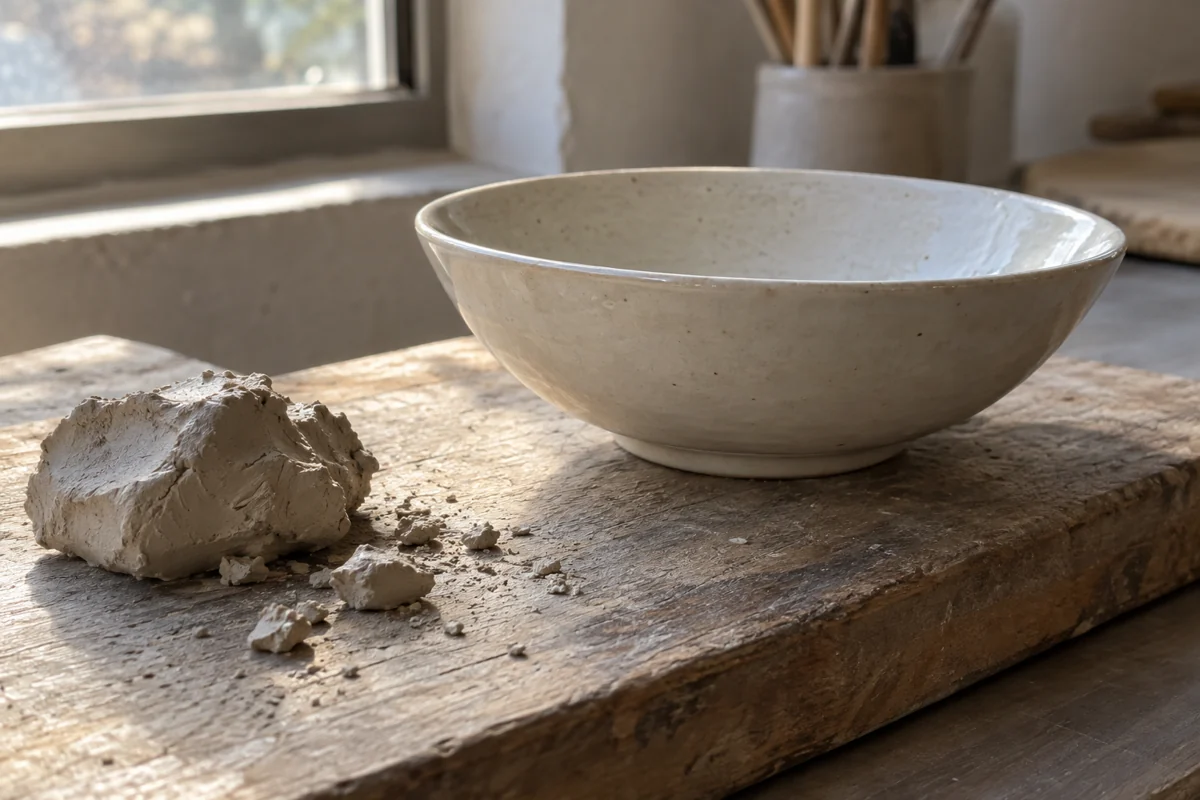
The museum's visitor rules prohibit photography, video and mobile-phone use inside the exhibition rooms. Put the phone away there and ask staff where any note-taking or photography is permitted. The illustration accompanying this article is fictional; it is not a photograph of the collection or an example authenticated as Yanggu porcelain.
PRACTICAL DETAILS · Regular hours are not a holiday promise
The museum and VISITKOREA list normal hours of 10 AM–6 PM, with last admission at 5:30 PM. The museum normally closes Mondays; its own guide specifies a next-weekday closure when a Monday public holiday is open. The standard admission table lists KRW 3,000 for visitors aged 8–64, with age-based free entry for children 7 and under and adults 65 and over. Other exemptions have separate conditions.
A separate museum notice advertises an app-based admission and activity voucher scheme, not unconditional free entry for everyone. Do not build an itinerary around a voucher until eligibility and availability are confirmed. Making activities are also distinct from ordinary museum admission; ask which activity is running, its price and whether booking is needed.
For the approaching holiday, the museum's September 9 notice says it will open at 1 PM on September 25, 2026, after a morning closure. Confirm holiday arrangements directly before travelling. The museum's published enquiry number is +82-33-480-7238; English assistance and transport connections have not been verified for this guide.
TAKE IT FURTHER · Keep two questions for the next shop
On your next ceramics stop, separate 'Who made this?' from 'What can you tell me about the material?' A maker may know both answers, one, or only part of the history. Listen for that difference without treating uncertainty as a flaw.
That is the useful souvenir from this story: a way to ask more precise questions. A finished vessel can lead your attention outward—to a place that supplied the clay, to the work of making, and to the evidence that connects them—without requiring you to buy anything.
THE SEOULIAN SIGNAL · EDITORIAL INTERPRETATION
Why this matters
Distinguish the clay's origin from the kiln's location. At Yanggu, also distinguish ordinary admission from separately arranged making activities and conditional vouchers.
SOURCE DESK · RESEARCH RECORDS
Research used for this analysis
- Yanggu Porcelain Museum, accessed September 14, 2026 Korea Tourism Organization · VISITKOREA · Independent national institution: Bangsan pottery, Joseon raw-material connection to Gyeonggi Gwangju, museum contents and cross-check of address, regular hours and standard entry prices.
- Introduction to Yanggu porcelain, checked September 14, 2026 Yanggu Porcelain Museum · Primary museum historical interpretation: local production and white-clay supply to Bunwon. No primary archival quotation or contested historical claim reproduced.
- Visitor information, checked September 14, 2026 Yanggu Porcelain Museum · Primary current hours, age-based standard admission, holiday-Monday rule and exhibition-room photography/phone restriction.
- Chuseok holiday notice, published September 9, 2026 Yanggu Porcelain Museum · Primary specific September 25 afternoon reopening notice, read September 14; not an independent institution from the other museum pages.
- Conditional museum voucher notice, published August 6, 2026 Yanggu Porcelain Museum · Distinguishes an app-application voucher program from the standard admission table; no eligibility or remaining availability assumed.
Original synthesis & image rights
Original SEOULIAN synthesis of linked institutional facts and independently written questions about material provenance. No source prose, museum photographs, collection designs or posters reproduced. Museum pages represent one institution; Korea Tourism Organization provides independent national context. The built-in Imagegen cover is fictional and disclosed, not authenticated Yanggu porcelain or local clay. No firsthand visit or voucher availability claimed. Targets and reported usage remain attributed to the city and are not presented as independently verified outcomes.
Image disclosure
Credit: AI-generated editorial illustration; not documentary evidence. A fictional bowl and clay still life, not a museum object, documented Yanggu porcelain or authenticated local clay.
Creator: SEOULIAN with ChatGPT Image Generation
Source type: SEOULIAN imagegen editorial photo
Disclosure: AI-generated editorial illustration; not documentary evidence. A fictional bowl and clay still life, not a museum object, documented Yanggu porcelain or authenticated local clay.
License: Original SEOULIAN AI-generated editorial image