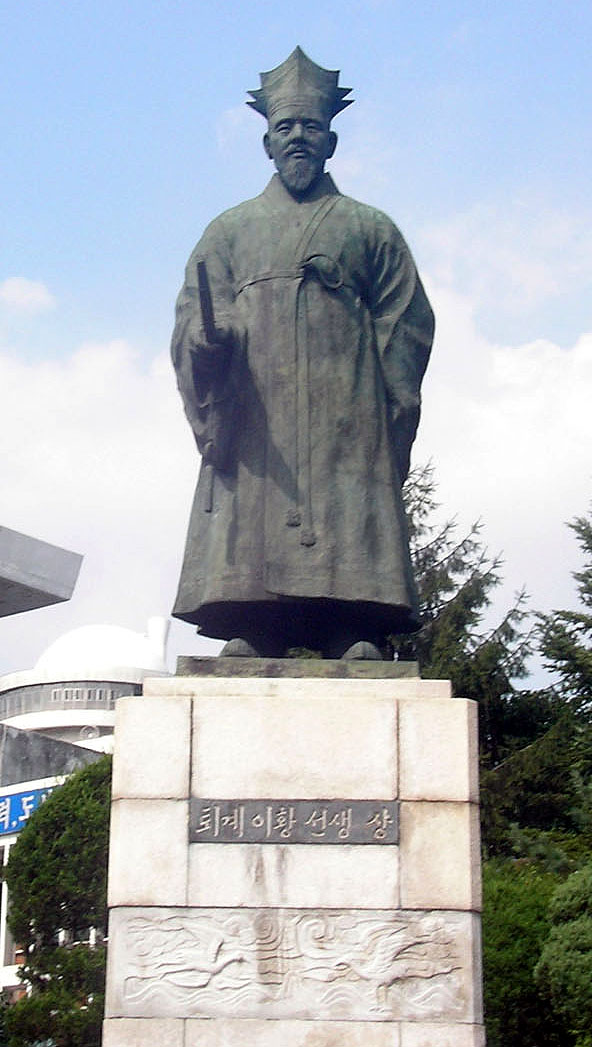
Yi Hwang (Korean: 이황; Hanja: 李滉; 1501–1570) was a Korean philosopher, writer, and Confucian scholar of the Joseon period. He is considered the most important philosopher of Korea - he is honored by printing his portrait on the 1000 South Korean won banknote, on the reverse of which one can see an image of his school, Dosan Seowon. He was of the Neo-Confucian literati, established the Yeongnam School and set up the Dosan Seowon, a private Confucian academy. Yi Hwang is often referred to by his art name Toegye ("Retreating Creek"). His courtesy name was Gyeongho. His interpretation of Neo-Confucianism was influential not only in Korea, but also in Japan, Taiwan, and Vietnam, and is now being studied even in the mainland China. His main work, Ten Diagrams on Sage Learning, originally published in classical Chinese language, has been already translated into modern Korean, Japanese, Vietnamese, English, French, German, Russian and Polish. Some of his writings were looted by the Japanese military during the Japanese invasion of Korea.
Read the fixed source
Follow the exact revision used for this summary, or open its history to see the contributors and later changes.
Text source & license
Adapted and shortened by SEOULIAN from the linked fixed revision; no change in factual meaning is intended. Source: Wikipedia contributors. This adapted summary is shared under CC BY-SA 4.0.
Image attribution
Title: Statue of Yi Hwang
Author: Integral
Source: Wikimedia Commons
License: CC BY-SA 2.0 kr
Wikimedia thumbnail downloaded and displayed without editorial alteration.