SEOULIAN INTERPRETATION · An invitation, not a vocabulary test
A first game of yutnori (윷놀이) can begin with a small request: show me what the sticks mean. You do not need to understand every excited comment around the board. Start by reading the throw; the choices about pieces and routes can come next, with someone pointing them out.
That is SEOULIAN's suggested way in. Instead of memorizing a page before joining, let the first round be a demonstration. Make room for a newcomer to ask why a piece moved there, and the game becomes a conversation with something concrete at its center.
VERIFIED CONTEXT · A race with shared pieces
Seoul's official traditional-culture guide identifies three essentials: the throwing sticks, a board and playing pieces. It places yutnori in the period from Lunar New Year's Day to the first full moon. The National Folk Museum of Korea describes the same seasonal tradition. This article is a game introduction, not an announcement of a current festival.
The Korea Society's teaching handout presents a two-team version with four pieces per side. The aim is to bring all four around the course. Unlike a game where everyone has one fixed pawn, a team can think about its pieces together.
READ THE THROW · Count the flat faces
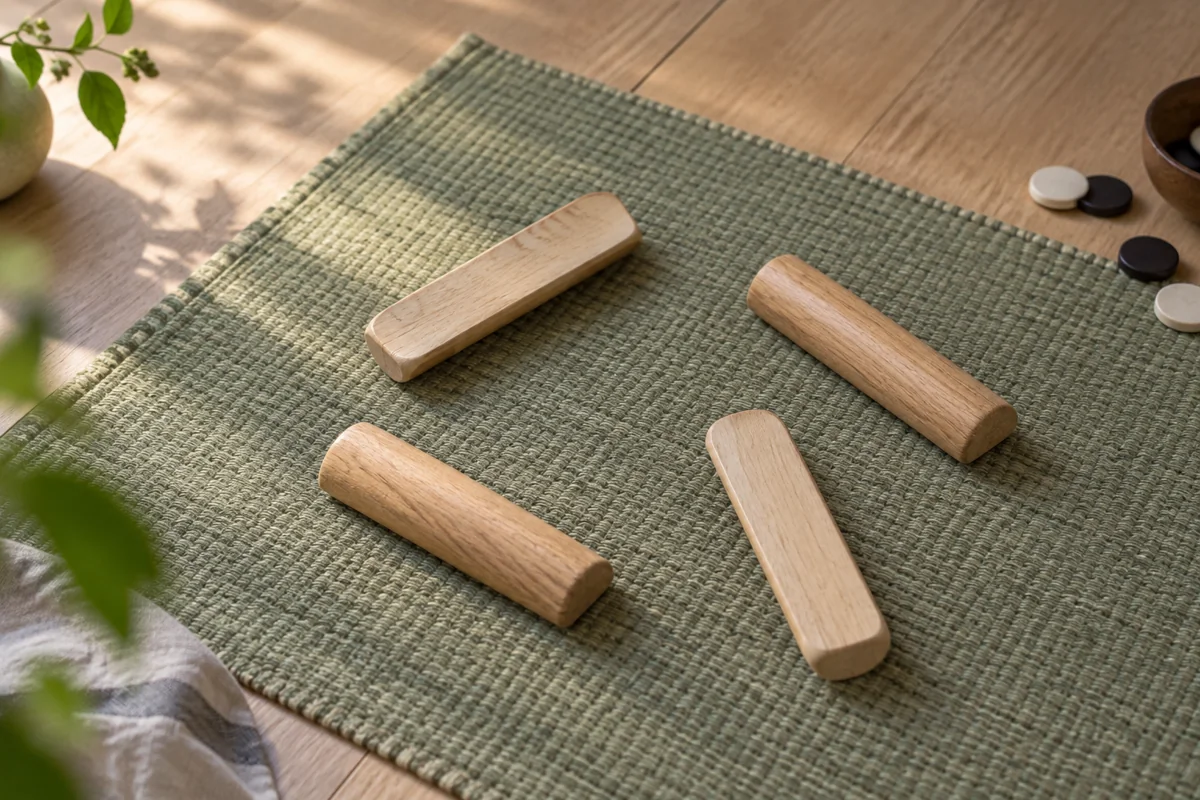
Each wooden stick has a flat face and a rounded back. Both the museum's account and The Korea Society's handout give the same basic scoring pattern. Look at how many flat faces point upward after all four sticks settle:
One flat face up is do (도): move one space. Two is gae (개): two spaces. Three is geol (걸): three spaces. Four is yut (윷): four spaces. If no flat face is up, the result is mo (모): five spaces.
The museum also describes another throw after yut or mo. Keep the five names beside the board at first; recognizing a result matters more than pronouncing it perfectly.
VERIFIED RULES · Why the route matters
The Korea Society's handout shows a square outer circuit with routes through the center. A piece must land on an eligible junction to take a shortcut on its next move; simply passing that point is not the same thing. Ask an experienced player to trace the legal route before you move.
The same guide describes two useful twists. Landing on a teammate's piece lets the pieces travel together. Landing on an opponent's piece removes it from the board and earns another turn. These are reasons to look beyond the piece nearest the finish.
SEOULIAN's suggestion: after one throw, pause and compare two possible moves. Would you rather advance a piece alone, join your own pieces or approach an opponent? There need not be a perfect answer for the pause to be enjoyable.
TRY IT · Agree before the first throw
Use the instructions supplied with your set and settle any extra house rules together. Ask someone to demonstrate the starting corner, legal shortcuts and what counts as finishing. These are easier to understand when a person traces the board than when several people try to explain at once.
For a practice round, keep the scoring reminder visible and invite questions before each move. Choose a clear, flat playing area, move breakable objects away and toss gently. If floor seating is uncomfortable, suggest a suitable table. These are practical suggestions, not requirements of a single official competition rulebook.
The linked Korea Society PDF includes a board and rules on its printed pages 44–45; the National Folk Museum's seasonal encyclopedia explains the five throw outcomes on printed page 109. Sources were checked on September 18, 2026 (UTC). Leave the first game knowing how to join the next one, rather than worrying about whether you looked experienced.
THE SEOULIAN SIGNAL · EDITORIAL INTERPRETATION
Why this matters
For a first game, agree on the finish and any extra house rules before the first throw. Learn the score, then ask which piece has the most useful move.
SOURCE DESK · RESEARCH RECORDS
Research used for this analysis
- Traditional Culture — Yutnori (Korean board game) Seoul Metropolitan Government · Primary municipal cultural guide for sticks, board, pieces and the traditional first-lunar-month context. Its brief finish description is not used as a full rulebook. Checked September 18, 2026 UTC; no images reused.
- Let's Go to Korea — Elaine Tegovich; How to Play Yut and Yut Board, printed pages 44–45 The Korea Society · Independent educational nonprofit's authored lesson: two teams, four pieces, flat/rounded faces, five scores, junction-based shortcuts, grouping and capture. PDF pages 17–18 inspected; no diagram or worksheet reproduced. Checked September 18, 2026 UTC.
- Encyclopedia of Korean Seasonal Customs — The 1st Lunar Month; Yunnori, printed page 109 National Folk Museum of Korea · Primary museum reference cross-checking the first-lunar-month context, five basic throw outcomes and extra throw for yut/mo. PDF page 43 inspected. Origin theories, animal-name theories and the supplementary dwit-do variant are outside this guide. Checked September 18, 2026 UTC; no source media reproduced.
Original synthesis & image rights
Original SEOULIAN English synthesis, not a translation or reproduction of an educational handout. Sources are linked for fact-checking; no source diagram, photograph, worksheet or text passage is reproduced. The cover was made with built-in ChatGPT Image Generation and depicts generic, unbranded game materials, not an event, museum collection or technical rules diagram. AI-generated editorial illustration; not documentary evidence. Targets and reported usage remain attributed to the city and are not presented as independently verified outcomes.
Image disclosure
Credit: SEOULIAN · Created with ChatGPT Image Generation.
Creator: SEOULIAN with ChatGPT Image Generation
Source type: SEOULIAN imagegen editorial photo
Disclosure: AI-generated editorial illustration; not documentary evidence. Generic unbranded yut sticks and counters, not an event photograph, museum object or technical rules diagram.
License: Original SEOULIAN AI-generated editorial image