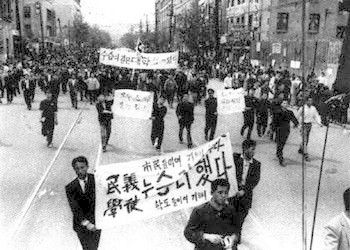
The April Revolution (Korean: 4.19 혁명), also called the April 19 Revolution or April 19 Movement, were mass protests in South Korea against President Syngman Rhee and the First Republic from April 11 to 26, 1960, which led to Rhee's resignation. Protests opposing Rhee were started by student and labor groups in the southeastern port city of Masan on April 11. The protests were triggered by the discovery of the body of a local high school student killed by police during demonstrations against rigged elections in March. Popular discontent had arisen due to Rhee's autocratic rule, corruption, use of violence against political opposition, and uneven development of South Korea. The Masan discovery led to large student protests in Seoul, which were violently suppressed; a total of 186 people were killed during the two weeks of protest. Rhee resigned on April 26 before fleeing to exile in the United States, and was replaced by Yun Posun, beginning the transition to the Second Republic of South Korea.
Read the fixed source
Follow the exact revision used for this summary, or open its history to see the contributors and later changes.
Text source & license
Adapted and shortened by SEOULIAN from the linked fixed revision; no change in factual meaning is intended. Source: Wikipedia contributors. This adapted summary is shared under CC BY-SA 4.0.
Image attribution
Title: 4.19 혁명
Author: Unknown author Unknown author
Source: Wikimedia Commons
License: Public domain
Wikimedia thumbnail downloaded and displayed without editorial alteration.