A flexible object
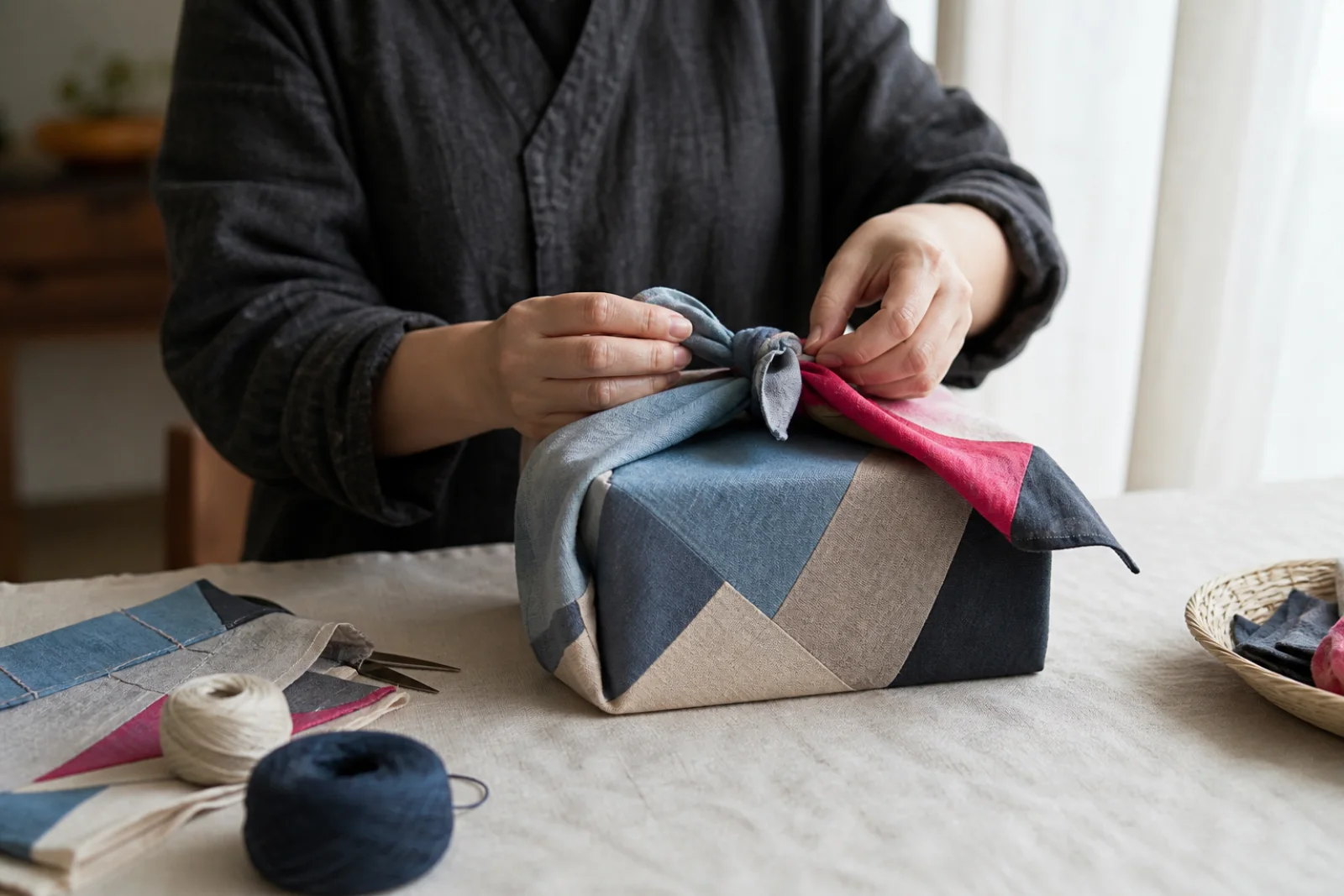
Bojagi is a broad term for Korean wrapping cloths used in domestic, ceremonial, and practical contexts. A flat textile becomes a bag, cover, bundle, or presentation according to the object and knot. Because the form is not fixed, storage occupies little space and the cloth can return for another use.
Patchwork records attention
Some historical bojagi join small pieces of fabric into geometric compositions, making use of remnants while displaying extraordinary color judgment and sewing. Not every bojagi is patchwork, and not every example was made for the same social setting. Museums and craft sources help distinguish material history from contemporary lifestyle branding.
Wrap for the next person
A modern reusable wrap succeeds when the receiver knows it can circulate. Choose a clean cloth appropriate to the object, protect food separately, and use a knot that is secure without becoming a puzzle. The gesture adds care without requiring disposable decoration, but it should never become an obligation to buy an ornate accessory.
THE SEOULIAN NOTE · EDITORIAL INTERPRETATION
The detail worth carrying forward
Bojagi design begins with a relationship between cloth, object, carrier, and receiver. Its beauty changes as the bundle moves.
SOURCE DESK · VERIFIED FACT TRAIL
Research used for this field note
- Visit Korean Heritage Korea Heritage Agency · Official heritage interpretation and visitor reference
- Korea Monthly Archive Korean Culture and Information Service · Public cultural and creative-industry context
Original synthesis, source trail attached
Original SEOULIAN synthesis. Facts are attributed through linked sources; source wording, photographs, logos, and entertainment assets are not reproduced. The article does not reproduce source expression, third-party photographs, logos, maps, or entertainment assets.
Image disclosure
Credit: SEOULIAN original editorial image
Creator: SEOULIAN with ChatGPT Image Generation
Source type: SEOULIAN imagegen editorial photo
Disclosure: AI-generated editorial illustration; not documentary evidence of a specific person, place, object, or event.