The Korean War (25 June 1950 – 27 July 1953) was an armed conflict fought on the Korean Peninsula between North Korea (Democratic People's Republic of Korea; DPRK) and South Korea (Republic of Korea; ROK) and their allies. North Korea was supported by China and the Soviet Union, while South Korea was supported by the United Nations led by the United States under the auspices of the United Nations Command (UNC). After the end of World War II in 1945, Korea, which had been a Japanese colony for 35 years, was divided by the Soviet Union and the United States into two occupation zones at the 38th parallel, with plans for a future independent state. The zones formed their own governments in 1948 due to political disagreements. North Korea was led by Kim Il Sung in Pyongyang, and South Korea by Syngman Rhee in Seoul; both claimed to be the sole legitimate government of all of Korea. Both sides engaged in extensive border clashes while Rhee's government suppressed communist uprisings at Jeju and Yeosu-Suncheon. On 25 June 1950, North Korea's Korean People's Army (KPA) launched an invasion of South Korea. In the absence of the Soviet Union's representative, the UN Security Council denounced the invasion, calling on member states to help repel the invasion. UN forces under the unified command comprised 21 countries, with the US providing around 90% of military personnel. On 27 June 1950 President Harry S. Truman ordered US air and sea forces to aid South Korea. Seoul was captured by the KPA on 28 June, and by early August, the Republic of Korea Army (ROKA) and its allies were nearly defeated, holding onto only the Pusan Perimeter in the peninsula's southeast. On 15 September, UN forces landed at Inchon near Seoul, cutting off KPA troops and supply lines. UN forces broke out from the perimeter on 18 September, recaptured Seoul, and invaded North Korea in October, capturing Pyongyang and advancing towards the Yalu River (border with China). On 19 October, the Chinese People's Volunteer Army (PVA) crossed the Yalu and entered the war on the side of the North. UN forces retreated from North Korea in December, following the PVA's first and second offensive. Communist forces captured Seoul again in January 1951 before losing it to a UN counter-offensive two months later. After an abortive Chinese spring offensive, UN forces retook territory roughly up to the 38th parallel.
Read the fixed source
Follow the exact revision used for this summary, or open its history to see the contributors and later changes.
Text source & license
Adapted and shortened by SEOULIAN from the linked fixed revision; no change in factual meaning is intended. Source: Wikipedia contributors. This adapted summary is shared under CC BY-SA 4.0.
Image attribution
Title: Korean War — SEOULIAN Imagegen editorial photograph
Author: SEOULIAN with ChatGPT Image Generation
Source: SEOULIAN imagegen editorial photo
License: SEOULIAN AI-generated editorial image
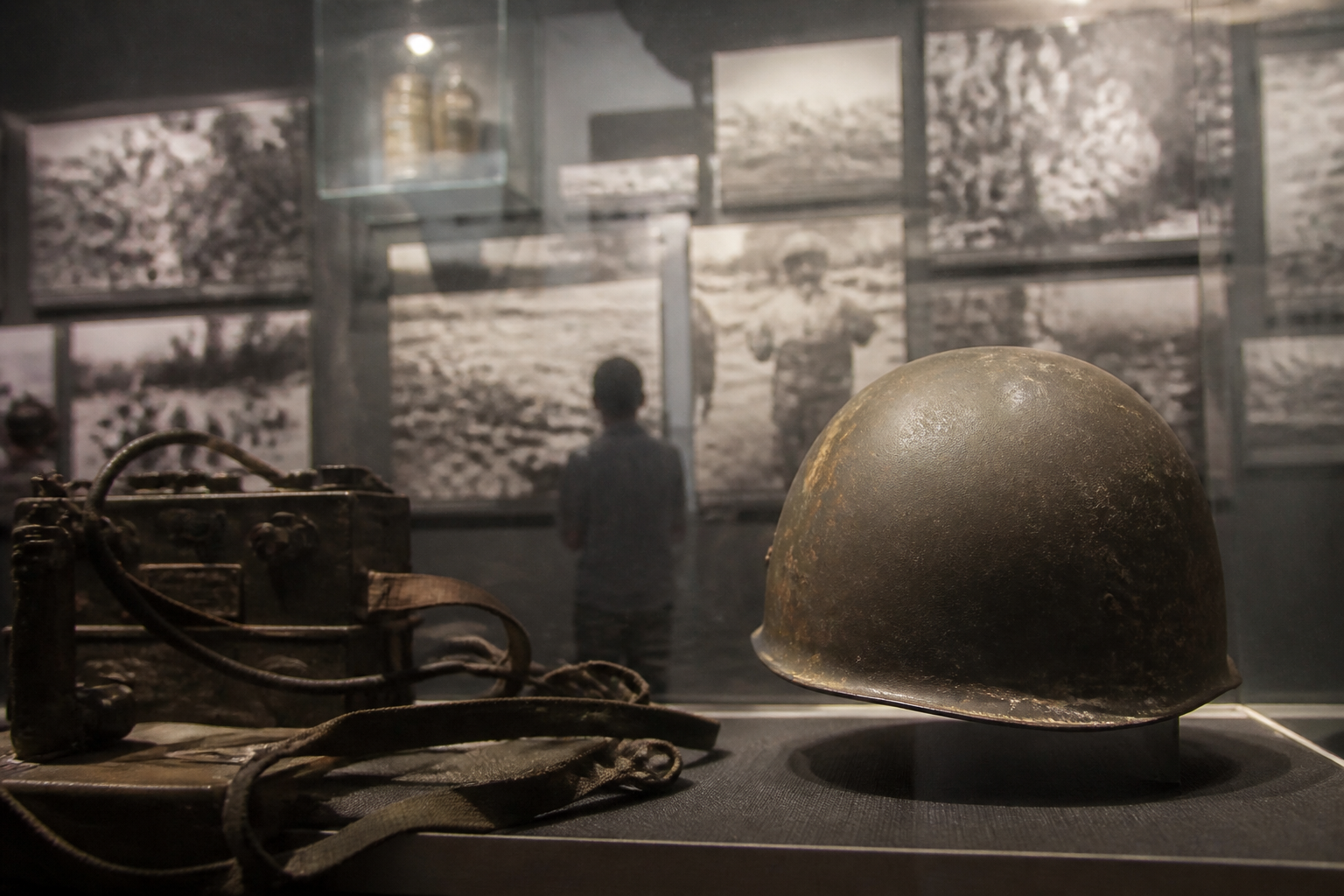
AI-generated editorial illustration created with ChatGPT Image Generation; illustrative and not documentary evidence.