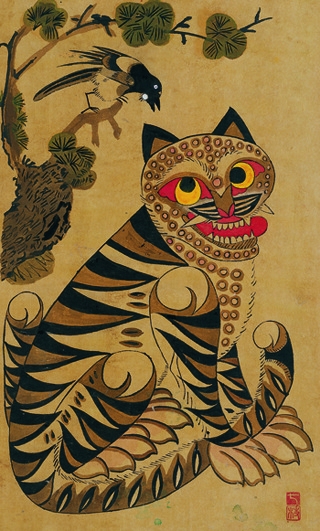
Minhwa (Korean: 민화; Hanja: 民畵) refers to Korean folk art produced mostly by itinerant or unknown artists without formal training, emulating contemporary trends in fine art for the purpose of everyday use or decoration. This type of painting was often the work of anonymous craftsmen who faithfully adhered to the styles, canons and genres inherited from the past. Minhwa also involved a magical dimension. They were believed to possess beneficial virtues and to protect the owner and his family from evil forces. They feature popular themes such as cranes, rocks, water, clouds, the sun, moon, pine trees, tortoises, insects and flowers, painted onto paper or on canvas throughout the Chosun era (1392–1910). As Yoon (2020) notes, Minhwa was a traditional art form intimately connected to the lives of the Korean people, best embodying the Korean sentiment (p. 14). As one of the rare art traditions in which the aesthetic sensibilities and spiritual aspirations of ordinary people found direct visual form outside the elite court and literati painting traditions, Minhwa occupies a distinctive place in the history of East Asian painting. Created freely by and for the common people, it stands as an authentic record of Korean folk culture and everyday life across centuries. Historically, this tradition was known as sokhwa (俗畵; 속화), meaning "folk painting," a term recorded in the 19th-century encyclopedic work Ojuyeonmunjangjeonsango (五洲衍文長箋散稿) by scholar Yi Gyugyeong (1788–1865), who described it as paintings found on folding screens, scrolls, and walls of ordinary households. The term minhwa (民畵), now the standard academic designation worldwide, was introduced in the early 20th century by Japanese aesthetician Yanagi Sōetsu, who brought this Korean tradition to international attention. However, its use remains a subject of debate among Korean scholars and artists, some of whom argue that sokhwa more authentically reflects the tradition's identity as it was understood from within Korean society itself, predating outside designation by centuries. Its roots stretch back to the very beginnings of the Joseon dynasty, first taking shape within the walls of the royal court before spreading to the common people. Minhwa began being used in palaces by royal court painters before anonymous artists adopted and dispersed their art to the populace to convey messages, ward away evil spirits, and wish for good things to happen.
Read the fixed source
Follow the exact revision used for this summary, or open its history to see the contributors and later changes.
Text source & license
Adapted and shortened by SEOULIAN from the linked fixed revision; no change in factual meaning is intended. Source: Wikipedia contributors. This adapted summary is shared under CC BY-SA 4.0.
Image attribution
Title: Minhwa-Tiger and magpie-03
Author: Anoymous
Source: Wikimedia Commons
License: Public domain
Wikimedia thumbnail downloaded and displayed without editorial alteration.