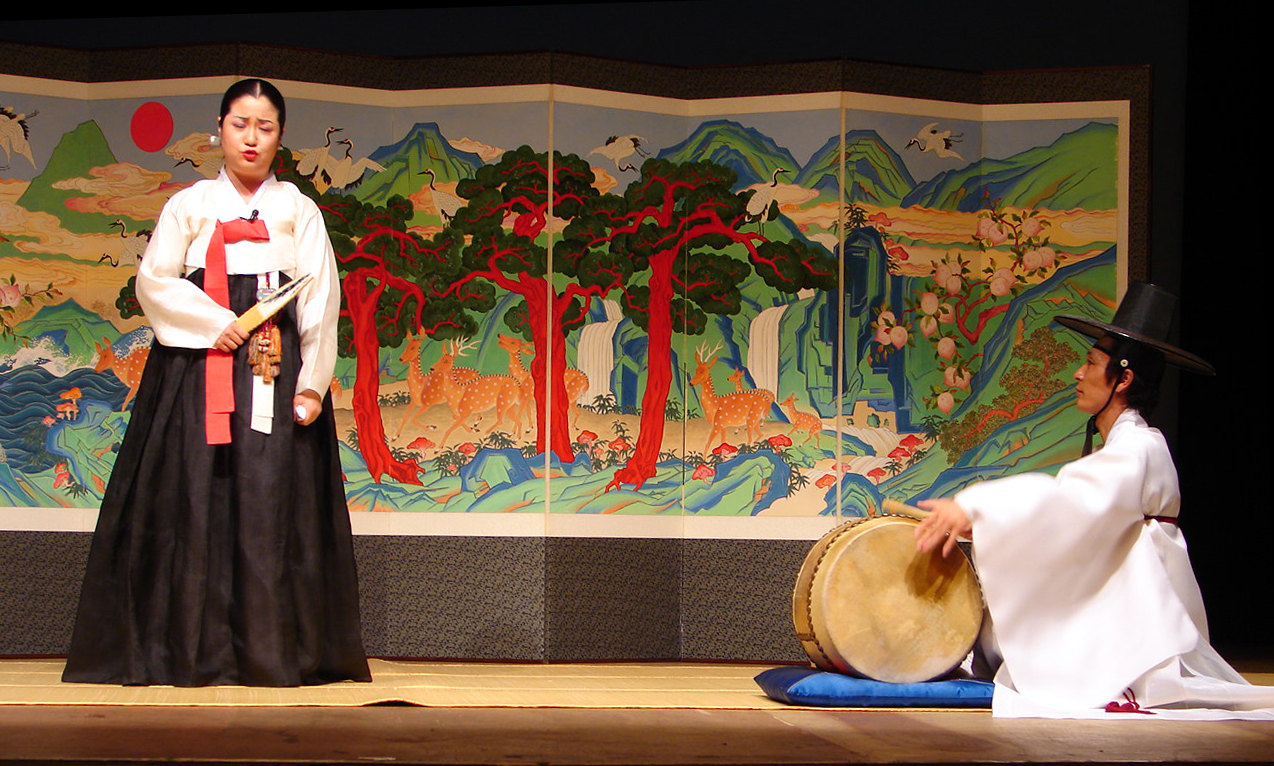
Pansori (Korean: 판소리) is a Korean genre of musical storytelling performed by a singer and a drummer. The term pansori is a compounds of the Korean words pan 판 and sori 소리, the latter of which means "sound." However, pan has multiple meanings, and scholars disagree on which was the intended meaning when the term was coined. One meaning is "a situation where many people are gathered." Another meaning is "a song composed of varying tones." In music, Gugwangdae describes a long story that takes as little as three hours and as much as eight hours or more. It is one of the traditional forms of Korean music that mixes body movements and songs to the accompaniment of a buk drum played by a gosu. The dramatic content of the drama is changed according to various rhythms based on the melody of Korea's local music. Pansori was originally called the "sori", and it was called Taryeong, Japga (잡가; 雜歌), Clown Song, and Geukga (극가; 劇歌). It was also commonly used in terms such as Changgeukjo (창극조; 唱劇調). In the late 20th century, the sorrowful "Western style" of pansori overtook the vigorous "Eastern style" of pansori, and pansori began being called the "sound of han". All surviving pansori epics end happily, but contemporary pansori focuses on the trials and tribulations of the characters, commonly without reaching a happy ending because of the contemporary popularity of excerpt performances. Such modern changes to the character of pansori, including its recent emphasis on han, have led to concern within the traditional performing community. Pansori has been designated as Korea's National Intangible Cultural Heritage No. 5 since 1964. On November 7, 2003, pansori was registered as the UNESCO's Masterpiece of the Oral and Intangible Heritage of Humanity of Korea. In 2011, the pansori practiced by the ethnic Koreans in China were also nominated as the UNESCO's intangible cultural heritage by the governments of Yanbian Korean Autonomous Prefecture and Tieling. Originally a form of folk entertainment for the lower classes, pansori was embraced by the Korean elite during the 19th century.
Read the fixed source
Follow the exact revision used for this summary, or open its history to see the contributors and later changes.
Text source & license
Adapted and shortened by SEOULIAN from the linked fixed revision; no change in factual meaning is intended. Source: Wikipedia contributors. This adapted summary is shared under CC BY-SA 4.0.
Image attribution
Title: Korea-Busan 3404-06 Pansori
Author: Steve46814
Source: Wikimedia Commons
License: CC BY-SA 3.0
Wikimedia thumbnail downloaded and displayed without editorial alteration.