The scale is real, but the meaning is in the small functions
Statistics Korea’s preliminary 2024 Franchise Survey counted 54,780 convenience-store franchise establishments. They represented 17.5 percent of all franchise establishments in the survey, and their annual sales reached KRW 28.495 trillion—24.2 percent of surveyed franchise sales. Those numbers describe a mature network, not a passing food trend.
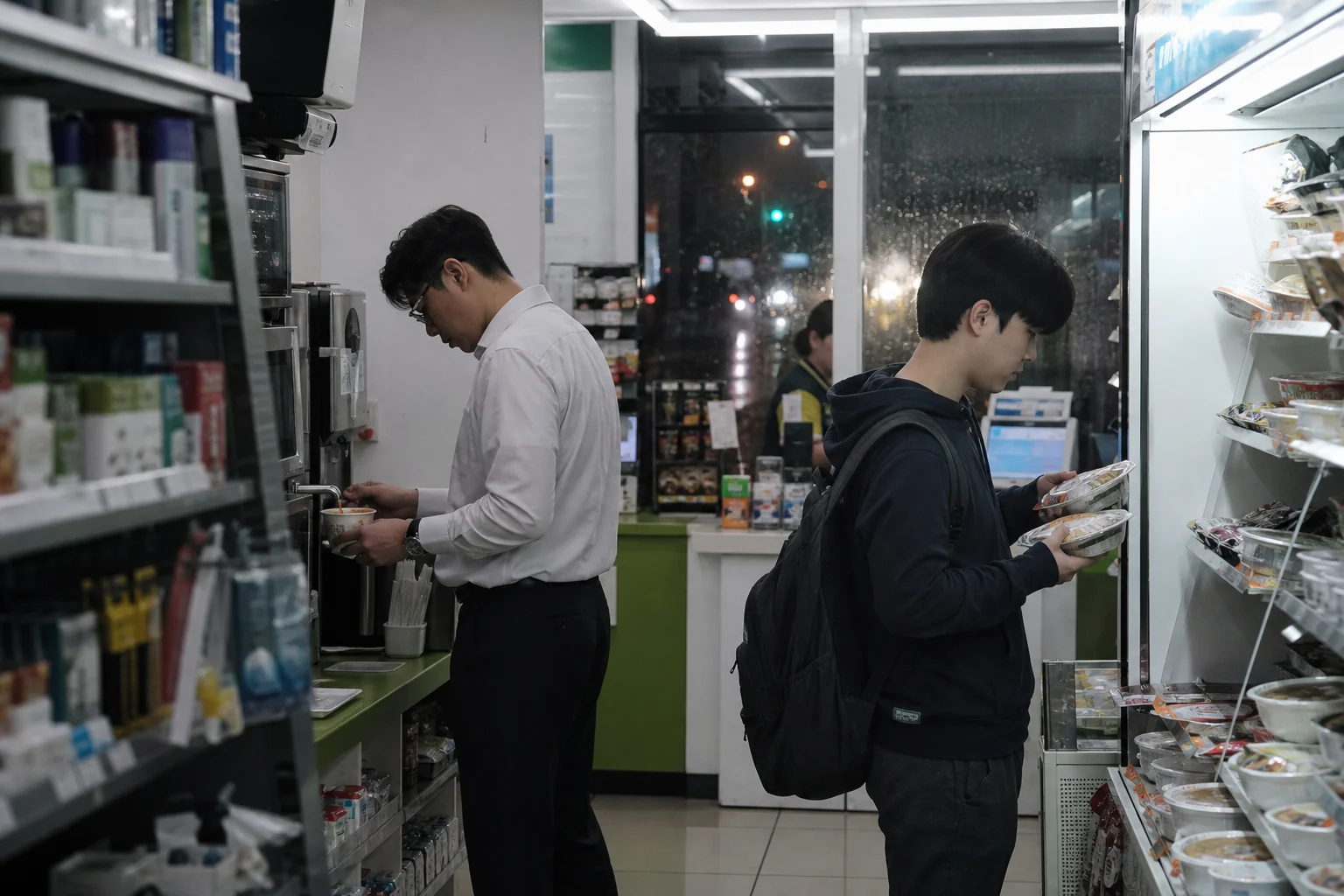
Scale alone does not explain why the format feels different in Korea. The useful unit is the branch at street level: close enough to enter without planning, bright enough to act as a late-night marker, and standardized enough that a customer already knows the basic sequence. Availability varies, but many branches combine retail with hot water, microwaves, small eating counters, ready meals, and other practical services.
A food system designed around one person and five minutes
The core meal grammar is modular. Samgak gimbap supplies rice and a compact filling; dosirak puts rice and side dishes in one tray; cup or packet ramyeon uses store-provided hot water or a cooker; milk, coffee, eggs, fruit, snacks, and small side dishes complete the meal. A customer can spend little, eat immediately, and avoid the social negotiation of taking a restaurant table alone.
Korea.net connects this pattern to busy schedules, late-night access, and the growth of honbap—eating alone. That does not make the convenience store a substitute for the full Korean table. It makes it a pressure valve. When the workday, study session, train arrival, or hotel check-in does not fit restaurant time, the store assembles a workable meal from small parts.
Why it became a media genre as well as a shop
Convenience-store mukbang, product reviews, and kkuljohap—‘honey combinations’ of separate products—turn private improvisation into shareable knowledge. Korea Tourism Organization guidance notes how younger customers circulate recipes and compare store-exclusive items. The shelf becomes a rapid testing ground where packaging, flavor, limited releases, and fandom collaborations can move from curiosity to online conversation within days.
That cycle explains the store’s frequent appearance in drama and variety content. It is visually legible and socially flexible: a character can wait, eat, recover, meet someone briefly, or delay going home. International viewers may first see a glamorous wall of snacks. Korean viewers also recognize a familiar room where very little explanation is required.
A first visit without turning it into a stunt
Begin with the need, not a viral shopping list. If you want a meal, choose one base—rice or noodles—then add rather than buying five competing mains. Check spice labels, allergens, and heating instructions; ask before using a seating area for a long stay; and separate waste according to the bins provided. Hot-water machines, cookers, tables, tax-refund tools, parcel functions, and payment methods differ by branch.
Promotions such as 1+1 mean ‘buy one, receive one,’ not half price for one item. Store-exclusive products can be interesting, but the most revealing observation is simpler: watch how the room handles several tempos at once. One customer is eating, another is topping up an ordinary day, and a third is using the lighted doorway as a brief pause between destinations.
THE LIVING SEOUL SIGNAL · EDITORIAL INTERPRETATION
What ordinary use reveals
The Korean convenience store is culturally powerful because it reduces friction without demanding celebration. Its promise is not abundance alone; it is that an ordinary need can be solved quickly, anonymously, and close to home.
SOURCE DESK · VERIFIED FACT TRAIL
Research used for this feature
- Preliminary Results of the 2024 Franchise Survey Statistics Korea · Official establishment and annual-sales figures for convenience-store franchises.
- Mukbang and Korea’s 24-Hour Convenience Culture Korea.net · Public cultural overview of eating facilities, honbap, and convenience-store media.
- Keeping Up with the Convenience Stores in Korea Korea Tourism Organization · Visitor-oriented explanation of products, promotions, recipes, and store differences.
Original synthesis, source trail attached
This article is SEOULIAN’s original multi-source synthesis. It does not reproduce product photography, package designs, brand marks, advertisements, influencer posts, or source expression. The article does not reproduce source expression, third-party photographs, logos, maps, or entertainment assets.
Image disclosure
Credit: SEOULIAN · Created with ChatGPT Image Generation
Creator: SEOULIAN with ChatGPT Image Generation
Source type: SEOULIAN imagegen editorial photo
Disclosure: AI-generated editorial illustration created with ChatGPT Image Generation; illustrative and not documentary evidence.